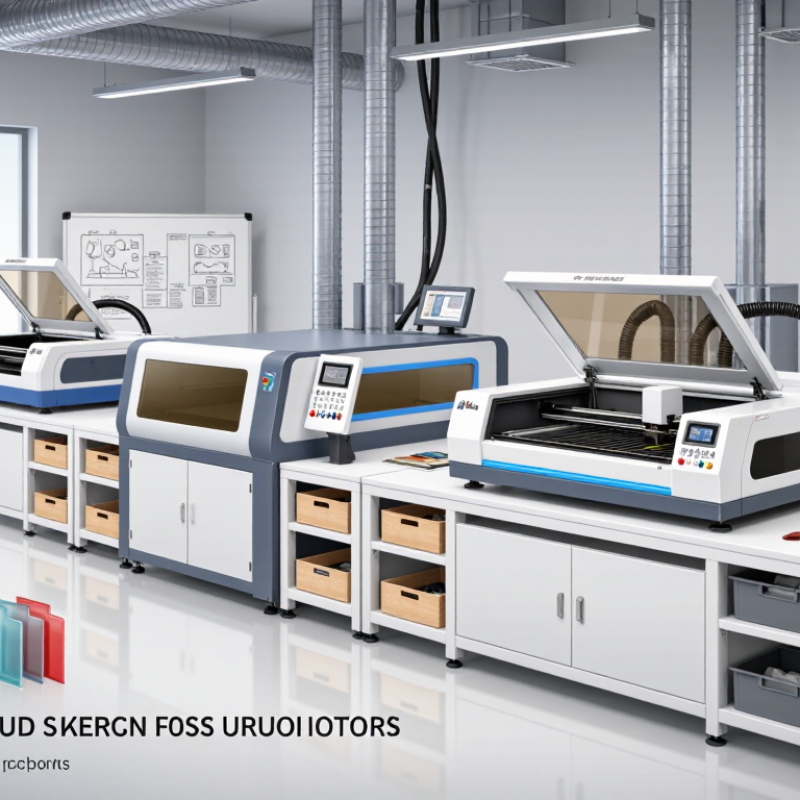
| Long-format working area | Common large-bed sizes include approximately 900 × 600 mm, 1300 × 900 mm, 1600 × 1000 mm, and 1600 × 1200 mm. | A larger bed supports sheet materials, signage, furniture panels, packaging prototypes, and batch production, but requires more floor space and ventilation capacity. | Confirm usable cutting area rather than the external cabinet size, maximum workpiece dimensions, pass-through capability, loading method, and required clearance around the machine. |
| CO₂ laser suitability | Typical power classes for large-format cutting are about 60–300 W, with 80–150 W commonly used for general non-metal cutting. | CO₂ wavelengths around 10.6 µm are well suited to wood, acrylic, paper, cardboard, leather, rubber approved for laser use, and many textiles. | Request measured cutting samples at the intended thickness. Higher wattage does not automatically guarantee better edge quality or higher productivity. |
| Diode laser suitability | Common optical output classes are approximately 5–40 W, with lower overall energy consumption than many CO₂ systems. | Diode systems can process selected wood, paper, leather, and dark opaque materials, but clear acrylic and many transparent materials transmit blue light and may not cut effectively. | Check optical output rather than electrical input power, cutting speed at the target thickness, autofocus performance, and compatibility with the planned material colors. |
| Fiber laser suitability | Typical marking systems use about 20–100 W; industrial metal-cutting systems can use substantially higher power and different machine architectures. | Fiber wavelengths near 1.06 µm are primarily used for marking or cutting metals such as stainless steel, mild steel, aluminum, brass, and coated metals. | Verify whether the system is designed for marking or through-cutting, along with metal thickness, work envelope, fume extraction, and required assist gas. |
| Maximum material thickness | Typical practical ranges are 3–10 mm for many diode applications and approximately 6–25 mm for CO₂ applications, depending on material and power. | Cutting capacity changes significantly with material density, moisture, resin content, lens focal length, air assist, speed, and the required edge quality. | Use supplier test cuts with the exact grade, thickness, color, and surface finish. Do not rely only on a maximum thickness advertised without conditions. |
| Permitted materials | Commonly suitable materials include untreated wood, some plywood, acrylic, paper, cardboard, leather, felt, and laser-rated rubber. | Material composition matters more than appearance. Adhesives, coatings, flame retardants, and plastic additives can change emissions and cutting behavior. | Obtain a material safety data sheet or manufacturer confirmation before processing unfamiliar sheets, composites, coatings, or imported materials. |
| Prohibited or high-risk materials | PVC, vinyl, halogen-containing plastics, unknown composites, and materials containing chlorine or fluorine should not be laser processed without qualified technical approval. | PVC can release corrosive chlorine-containing gases and damage equipment. Some plastics can also produce toxic fumes, fire hazards, or persistent residues. | Require a written material compatibility list, suitable extraction specifications, and a clear emergency procedure. |
| Laser safety classification | An enclosed machine may be designed as a Class 1 product, while an open or inadequately enclosed system can expose users to higher laser classes. | Laser classification depends on accessible emission and enclosure design, not only on nominal laser power. | Check conformity with applicable local rules and standards such as IEC 60825-1, door interlocks, viewing-window protection, emergency stop, warning labels, and certification documents. |
| Fire prevention | Air assist, flame-resistant internal surfaces, automatic shutdown features, and continuous operator supervision are important controls. | Laser cutting can ignite wood dust, paper, acrylic residue, and improperly adjusted workpieces. A laser machine should not be left operating unattended. | Confirm air-assist flow, fire detection or suppression options, emergency-stop behavior, exhaust airflow, and the recommended fire extinguisher type for the installation. |
| Fume extraction | A dedicated exhaust system is normally required; airflow requirements vary by enclosure, material, duct length, filter type, and machine design. | Exhaust must remove smoke, particulates, odors, and potentially hazardous gases without creating excessive back pressure or unsafe discharge. | Verify airflow, static pressure, filtration stages, duct diameter, outdoor discharge rules, replacement-filter cost, and noise level in the target country. |
| Software and file formats | Useful formats commonly include SVG, DXF, PDF, and raster files such as PNG or JPG; exact support varies by controller software. | Vector files define cutting paths, while raster files are generally used for engraving. Color mapping, layers, units, and line-width rules affect job results. | Check operating-system support, offline operation, camera alignment, nesting, password or network controls, software language, updates, and export compatibility. |
| Motion accuracy | For production purchasing, inspect repeatability, positioning accuracy, acceleration, and long-bed squareness rather than relying on speed alone. | Longer working areas can magnify alignment, belt tension, rail straightness, and thermal-expansion issues across the bed. | Request a measured accuracy and repeatability report over the full working area, including diagonal and edge-to-edge tests. |
| Electrical requirements | Depending on power, chiller, exhaust, and accessories, systems may require single-phase or three-phase supplies and different voltage/frequency configurations. | Voltage standards, plug types, grounding rules, and power quality differ between markets. | Confirm rated voltage, frequency, current, phase, protective devices, grounding, plug type, transformer requirements, and local electrical certification. |
| Cooling system | Water-cooled CO₂ systems commonly use a dedicated chiller or cooling unit; air-cooled systems are generally limited to lower-power applications. | Stable tube temperature is important for consistent output and service life. Ambient temperature and water quality affect cooling performance. | Check cooling capacity, temperature alarms, flow protection, approved coolant, freeze protection, ambient operating range, and service availability. |
| Routine maintenance | Inspect and clean optics, mirrors, bed surfaces, exhaust paths, and air-assist components regularly; check alignment and lubrication according to the manual. | Dust, resin deposits, condensation, misalignment, and restricted airflow can reduce power transmission, increase charring, and create fire risks. | Ask for a maintenance schedule, replacement-part list, optical cleaning procedure, alignment method, training materials, and expected consumable costs. |
| Consumable components | Typical consumables include lenses, mirrors, filters, belts, nozzles, coolant, exhaust components, and—on some CO₂ systems—the laser tube. | Service life varies with duty cycle, contamination, cooling, cleaning quality, power settings, and material throughput. | Confirm part numbers, local stock, lead times, warranty coverage, replacement skills required, and total cost of ownership over three to five years. |
| Global installation and support | Installation may require rigging, level flooring, ventilation, electrical work, compressed air, network access, and operator training. | Import duties, customs documentation, spare-part logistics, time zones, language, and local service capability can materially affect uptime. | Obtain installation drawings, packing dimensions, shipping weight, tariff classification, warranty terms, response times, remote-support method, and local compliance documents. |