-
PRODUCTS & SERVICESOptimized cooling solutions for modern data centersProducts & ServicesOptimized cooling solutions for modern data centers
-
CAPABILITIESAdvancing liquid cooling technologiesCapabilitiesAdvancing liquid cooling technologies
-
TechnologiesLiquid Cooling InnovationTechnologiesLiquid Cooling Innovation
-
RESOURCESLatest News & InformationResourcesLatest News & Information
-
ABOUTOur history, leadership and ownershipAboutOur history, leadership and ownership
-
CONTACTFacility locations and global operational footprint







2026 Top Vacuum Furnace Heat Treatment Equipment Guide
The 2026 Top Vacuum Furnace Heat Treatment Equipment Guide examines how modern furnaces support cleaner, tighter, and more repeatable production. Vacuum Furnace Heat Treatment removes oxygen from the chamber, reducing oxidation, scaling, and surface contamination. That matters when processing tool steel, titanium components, aerospace parts, and precision molds.
As metallurgy expert Dr. George E. Totten explains, “Heat treatment is the controlled heating and cooling of metals to change their properties.” This principle remains practical inside a vacuum furnace. Operators monitor temperature uniformity, pressure stability, gas quenching, loading patterns, and cooling rates. A bright component surface can still hide uneven hardness. That is where testing becomes essential.
This guide compares furnace types, heating systems, pumping performance, quenching methods, control technologies, and maintenance requirements. It also considers energy use and chamber size. Bigger is not automatically better. An oversized furnace may waste power and reduce process efficiency. A compact furnace may limit production flexibility.
Real experience often exposes the gap between specifications and results. Door seals age. Thermocouples drift. Fixtures distort airflow. Small details matter.
The discussion also recognizes an uncomfortable truth: no furnace guarantees perfect treatment without disciplined process control. Reliable results require validated recipes, calibrated instruments, documented inspections, and trained operators. Readers will find practical criteria for selecting equipment that fits materials, production volume, quality targets, and future expansion. Some recommendations remain conditional, because each factory has different constraints. That uncertainty deserves honest attention.
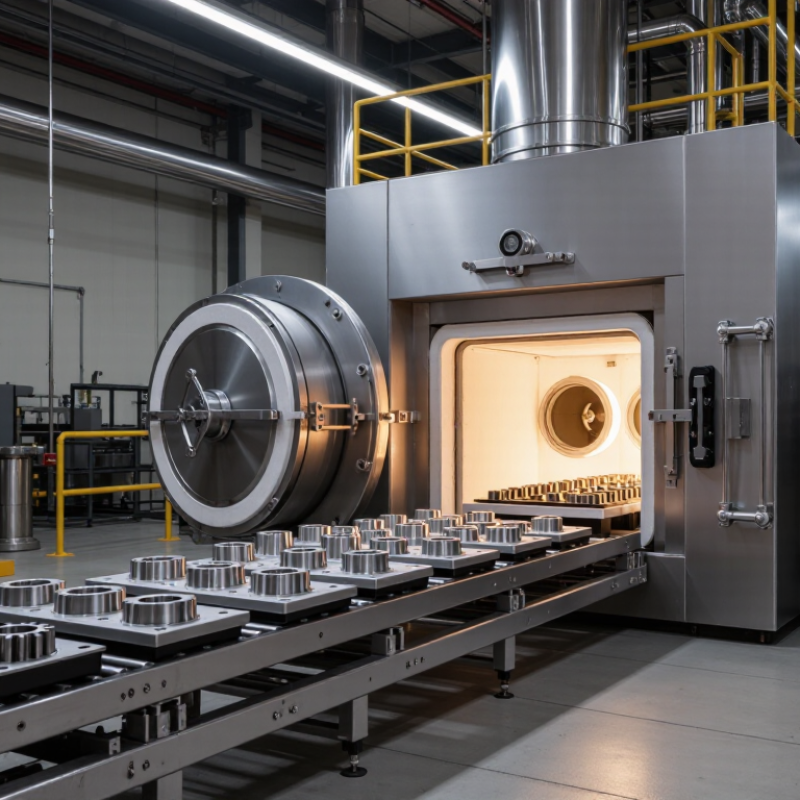
Table of Contents [Hide]
Vacuum Furnace Fundamentals: 10⁻²–10⁻⁶ mbar and 600–1,350°C
Vacuum furnace heat treatment depends on two working limits: pressure and temperature. Typical systems operate from 10⁻² to 10⁻⁶ mbar and 600–1,350°C. At 10⁻² mbar, the furnace reduces oxidation during routine heating. At 10⁻⁶ mbar, it supports cleaner processing for sensitive alloys and demanding surface requirements. Pressure alone does not guarantee quality.
A reliable cycle begins with clean loading and controlled pump-down. Oils, moisture, cutting fluids, and trapped air can cause pressure spikes. Watch the pressure curve, not only the final reading. A stable reading near 10⁻⁵ mbar may indicate proper outgassing, but it can also hide a small leak. That assumption is wrong. Leak testing and routine sensor checks remain essential.
Temperature uniformity matters just as much. A furnace rated for 1,350°C may not hold that temperature evenly across a heavy load. Use calibrated thermocouples and record the load temperature when possible. Thin parts may heat quickly, while dense fixtures respond slowly. Real cycles are less tidy. Operators should review ramp rates, soak time, cooling speed, and pressure changes after every run. In practice, the best equipment is not the fastest furnace, but the one that produces repeatable results with traceable data.