-
PRODUCTS & SERVICESOptimized cooling solutions for modern data centersProducts & ServicesOptimized cooling solutions for modern data centers
-
CAPABILITIESAdvancing liquid cooling technologiesCapabilitiesAdvancing liquid cooling technologies
-
TechnologiesLiquid Cooling InnovationTechnologiesLiquid Cooling Innovation
-
RESOURCESLatest News & InformationResourcesLatest News & Information
-
ABOUTOur history, leadership and ownershipAboutOur history, leadership and ownership
-
CONTACTFacility locations and global operational footprint







How to Choose a Pneumatic Conveying Blower?
Choosing a Pneumatic Conveying Blower is not simply a matter of selecting the largest motor or the highest advertised airflow. The blower must suit the material, conveying distance, pipe layout, and required production rate. A light plastic pellet behaves differently from a dense mineral powder. Even a small change in moisture or particle size can affect how material moves through a line.
Start with the system’s required airflow and pressure, then check how those figures change across actual operating conditions. Consider pipe diameter, bends, pickup points, filters, elevation, and the pressure losses each component creates. Blower type matters too: positive displacement and centrifugal designs have different operating characteristics. Neither is automatically the better choice. Noise, temperature, energy use, maintenance access, and available installation space also deserve attention. Small details matter.
Reliable sizing depends on sound data. Record the material’s bulk density and flow behavior, and ask the supplier to review the full system duty rather than a single headline number. Early estimates are useful, but they are not a substitute for measured operating information. That can be an uncomfortable limitation when a project is still being planned. Still, stating assumptions clearly is better than hiding uncertainty. This guide explains the questions to ask, the specifications to compare, and the trade-offs to examine before choosing a Pneumatic Conveying Blower.
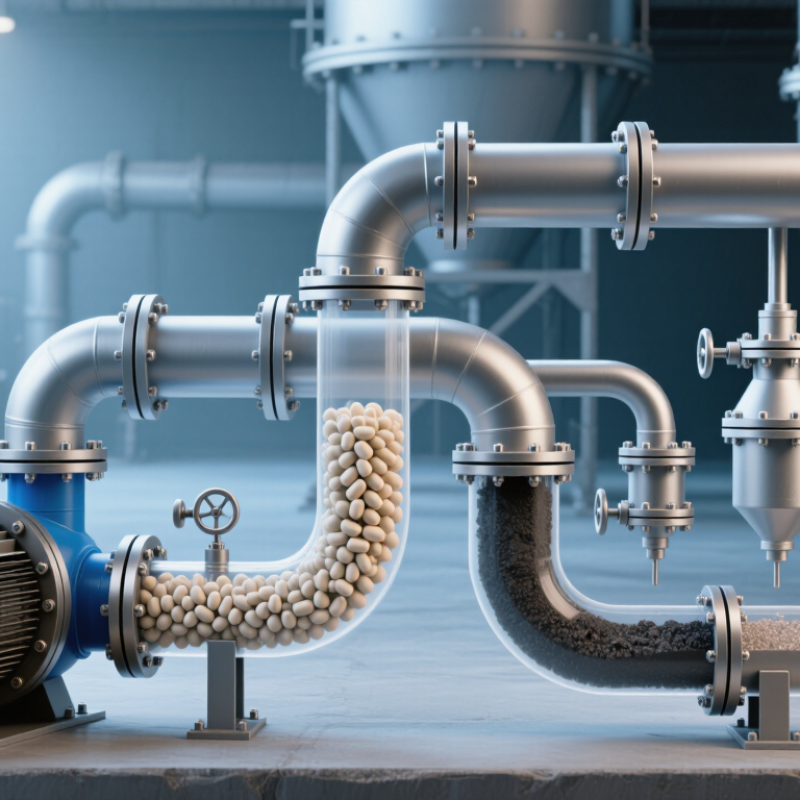
Table of Contents [Hide]
Define Conveying Phase: Dilute Flow Typically Runs at 15–30 m/s
Dilute-phase conveying keeps particles suspended in fast-moving air. A practical starting range is 15–30 m/s, as stated in the subtitle, but it is not a universal setting. David Mills’ Pneumatic Conveying Design Guide, 3rd edition (2016), discusses velocity as a key design variable in dilute-phase systems.
The right value depends on particle size, density, moisture, pipe diameter, and route length. A fine, dry powder may travel differently from coarse granules. That matters. Too little velocity can let material settle, especially after elbows or during startup. Excessive velocity can increase pipe wear, particle damage, and blower energy use.
Choose the blower around the required airflow and pressure at the conveying point, not just its headline power rating. Klinzing and co-authors’ Pneumatic Conveying of Solids, 3rd edition (2010), also treats conveying behavior as dependent on material properties and system conditions.
This is why a trial run or measured operating data can be more useful than a tidy estimate alone. Not always. Check the pressure drop across the full line, including bends, pickup points, and filters. Then confirm that the blower can maintain the target velocity under real loading.
Leave room to adjust: actual material can behave differently from a sample, and the first calculation may need revision.