-
PRODUCTS & SERVICESOptimized cooling solutions for modern data centersProducts & ServicesOptimized cooling solutions for modern data centers
-
CAPABILITIESAdvancing liquid cooling technologiesCapabilitiesAdvancing liquid cooling technologies
-
TechnologiesLiquid Cooling InnovationTechnologiesLiquid Cooling Innovation
-
RESOURCESLatest News & InformationResourcesLatest News & Information
-
ABOUTOur history, leadership and ownershipAboutOur history, leadership and ownership
-
CONTACTFacility locations and global operational footprint







What Is Copper Alloy Winding Wire?
Copper Alloy Winding Wire is an engineered conductor used in motors, transformers, generators, and other electromagnetic equipment. It combines copper’s excellent conductivity with selected alloying elements. These additions can improve strength, heat resistance, flexibility, or resistance to mechanical wear. The result is not simply ordinary copper wire with a different label. Its performance depends on alloy composition, wire diameter, insulation quality, and manufacturing accuracy.
Small details matter. A winding wire may pass through narrow slots, around sharp corners, or across thousands of repeated bends. In practical production, technicians inspect its surface for scratches, measure electrical resistance, and check insulation thickness. Engineers also evaluate elongation, tensile strength, thermal endurance, and resistance to vibration. Applicable industry standards can support consistent testing and traceability. However, a certificate alone does not guarantee suitable performance. The wire must match the equipment’s current load, operating temperature, winding method, and service environment.
Copper Alloy Winding Wire offers useful design possibilities. It may provide stronger coils where pure copper deforms too easily. It can also support compact winding structures and more stable operation under mechanical stress. Yet higher strength may involve reduced conductivity or greater material cost. That trade-off deserves careful review. A rushed selection can create excess heating, difficult winding, or shortened insulation life. Even experienced engineers can misjudge the balance. For this reason, reliable decisions combine supplier data, laboratory results, production experience, and application-specific testing. The right alloy is rarely universal. It is chosen for the real conditions inside the finished machine.
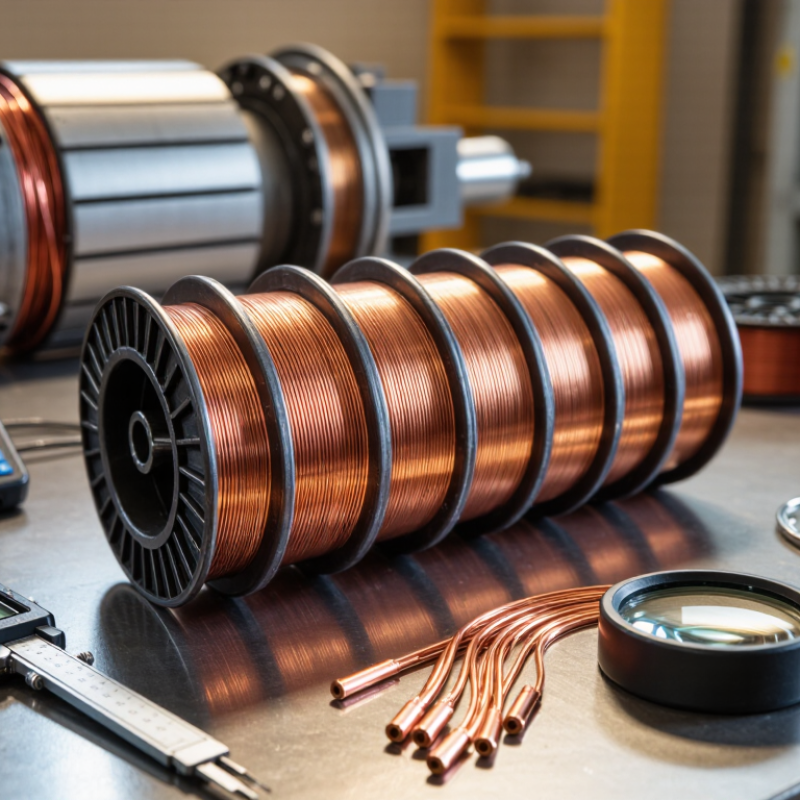
Table of Contents [Hide]
Definition and Basic Structure of Copper Alloy Winding Wire
What Is Copper Alloy Winding Wire?
Definition and Basic Structure of Copper Alloy Winding Wire
Copper alloy winding wire is an insulated conductor used to form coils in motors, transformers, relays, and sensors. Its core is mainly copper, combined with small amounts of other metals. These additions can improve strength, heat resistance, flexibility, or resistance to softening. They can also reduce electrical conductivity. That trade-off matters.
The structure is layered. At the center is the copper alloy conductor, usually round, rectangular, or square. Around it is a thin enamel insulation film. Some designs include bonding layers, glass coverings, paper, or protective overcoats. The outer surface must resist winding tension and contact with nearby turns. It is not merely colored metal.
During production, engineers control alloy composition, conductor size, surface cleanliness, and insulation thickness. A wire may look smooth, yet one tiny scratch can create a weak electrical point. Technicians commonly check diameter, resistance, insulation adhesion, flexibility, and surface defects. I have found that temperature changes affect handling; cold wire can feel less forgiving during tight bends. This detail is easy to miss.
The alloy core carries current, while the insulation separates neighboring turns electrically. Thousands of turns may fit inside a narrow slot. Small dimensional errors can reduce space efficiency or restrict heat removal. A practical mistake is choosing high strength without checking conductivity, temperature class, and winding tension together.