-
PRODUCTS & SERVICESOptimized cooling solutions for modern data centersProducts & ServicesOptimized cooling solutions for modern data centers
-
CAPABILITIESAdvancing liquid cooling technologiesCapabilitiesAdvancing liquid cooling technologies
-
TechnologiesLiquid Cooling InnovationTechnologiesLiquid Cooling Innovation
-
RESOURCESLatest News & InformationResourcesLatest News & Information
-
ABOUTOur history, leadership and ownershipAboutOur history, leadership and ownership
-
CONTACTFacility locations and global operational footprint







What Are Grounding Accessories and Why Are They Important?
Grounding Accessories are the small, often overlooked components that help connect electrical equipment to a grounding system. They include grounding clamps, bonding jumpers, grounding bars, lugs, test links, and earth electrodes. Their role is practical: provide a low-impedance path for fault current, reduce touch-voltage risk, and support protective-device operation. They are not decorative parts.
Industry guidance supports this function. NFPA 70, the National Electrical Code, requires effective grounding and bonding methods for many electrical installations. IEEE Standard 142, also called the Green Book, explains how grounding affects system performance, fault protection, and equipment reliability. OSHA electrical-safety guidance likewise emphasizes grounding paths that are permanent, continuous, and capable of carrying fault current. NFPA research reports on electrical fires repeatedly identify wiring, distribution equipment, and installation conditions as important risk factors. These findings give Grounding Accessories a clear safety purpose.
Small parts. Serious consequences.
A loose lug can create heat at a cable termination. Corrosion can increase resistance where the connection looks acceptable from outside. In field inspections, workmanship often matters as much as product selection. That point is easy to underestimate. A compliant clamp cannot compensate for an unsuitable electrode, poor torque, damaged conductors, or missing inspection records.
This topic deserves a careful, experience-based view. Grounding is not a single accessory or a one-time installation task. It is a coordinated system requiring correct design, compatible materials, verified continuity, and periodic inspection. Engineers and qualified electricians should confirm local requirements before installation. Even reliable standards cannot remove every uncertainty from real buildings, especially older sites with undocumented modifications.
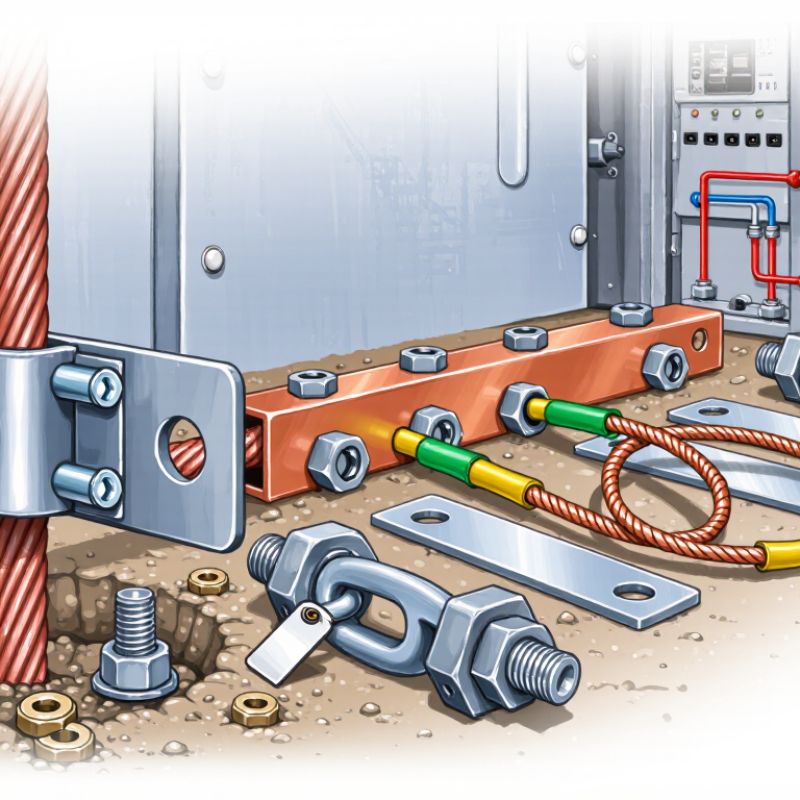
Table of Contents [Hide]
Definition and Purpose of Grounding Accessories
Grounding accessories are the connecting parts that create a dependable path between electrical equipment and the earth. They include grounding clamps, lugs, bonding jumpers, grounding bars, connectors, and electrode fittings. Their purpose is practical: to control unwanted electrical current and reduce dangerous voltage on exposed metal surfaces.
When an insulation fault occurs, current may reach a metal enclosure. A correctly installed grounding path directs that current toward the grounding system. This helps protective devices operate quickly. It can also reduce shock risks, equipment damage, and electrical noise. Bonding accessories connect separate metal parts, such as cable trays, panels, pipes, and enclosures, so they remain at a similar electrical potential.
Small details matter. A loose lug, painted contact surface, or corroded clamp can weaken the entire path. Field inspections often reveal problems around hidden connections. These include missing washers, poor tightening, and conductors bent too sharply. The accessory must match the conductor size, material, environment, and expected fault current. Outdoor installations need stronger corrosion resistance than dry indoor cabinets.
Grounding is not simply “adding a wire.” It is a coordinated system designed according to electrical standards and site conditions. Testing should confirm continuity and connection quality after installation. I would also avoid assuming that a visually clean connection is electrically reliable. That assumption can fail. Local regulations, qualified inspection, and accurate installation records remain important, especially in industrial or high-voltage areas.
What Are Grounding Accessories and Why Are They Important? - Definition and Purpose of Grounding Accessories
| Grounding Accessory | Definition | Primary Purpose | Typical Applications | Common Materials | Key Selection Considerations |
|---|---|---|---|---|---|
| Grounding Electrode | A conductive element installed in or in contact with the earth. | Provides a path for fault current, lightning current, and electrical system reference current to dissipate into the earth. | Buildings, substations, industrial facilities, communication sites, and renewable-energy installations. | Copper, copper-bonded steel, galvanized steel, or stainless steel. | Soil conditions, corrosion resistance, electrode dimensions, installation depth, and applicable electrical codes. |
| Grounding Conductor | A wire, cable, or metal strip that connects electrical equipment or system points to the grounding network. | Carries fault current and helps maintain a low-impedance path to the grounding electrode or source. | Power distribution systems, control panels, motors, generators, transformers, and telecommunications equipment. | Bare or insulated copper, aluminum where permitted, and copper-clad materials. | Required ampacity, short-circuit duty, mechanical protection, routing, insulation, and local code requirements. |
| Grounding Clamp | A mechanical connector used to attach a grounding conductor to an electrode, pipe, structural member, or other conductive surface. | Creates a secure and electrically continuous connection. | Ground rods, water pipes where permitted, building steel, cable trays, and equipment frames. | Bronze, copper alloy, stainless steel, or galvanized steel. | Conductor size range, electrode diameter, environmental exposure, corrosion compatibility, and mechanical strength. |
| Grounding Lug | A terminal or fitting designed to connect a grounding conductor to equipment or an enclosure. | Ensures exposed conductive parts are bonded to the grounding system. | Switchboards, electrical enclosures, machinery, cabinets, battery systems, and control equipment. | Tin-plated copper, copper alloy, stainless steel, or plated steel. | Mounting method, conductor capacity, enclosure material, vibration resistance, and protection against galvanic corrosion. |
| Bonding Jumper | A conductor that electrically connects two metallic parts that might otherwise have different electrical potential. | Maintains equipotential bonding and provides a reliable fault-current path across joints or movable sections. | Pipe sections, equipment doors, cable tray joints, flexible connections, and structural metalwork. | Flexible copper braid, stranded copper cable, or tinned copper. | Flexibility, current capacity, connection length, movement frequency, and exposure to moisture or chemicals. |
| Ground Bar | A conductive bar with multiple connection points for grounding and bonding conductors. | Organizes grounding connections and provides a common low-impedance bonding point. | Main electrical panels, telecommunications rooms, data centers, industrial control cabinets, and substations. | Copper, tin-plated copper, aluminum, or copper alloy. | Number of terminals, short-circuit current, mounting space, hole pattern, insulation from the enclosure, and corrosion protection. |
| Exothermic Welding Connection | A permanent connection formed by a controlled chemical reaction that fuses conductors or conductors to electrodes. | Creates a durable, low-resistance connection that is suitable for grounding and lightning-protection networks. | Buried grounding grids, substations, lightning-protection systems, rail systems, and industrial facilities. | Copper conductors, galvanized steel, stainless steel, and compatible welding materials. | Conductor geometry, material compatibility, connection type, site safety procedures, and qualified installation. |
| Grounding Inspection Well | An accessible enclosure installed over a grounding connection or electrode. | Protects the connection while allowing visual inspection, testing, and maintenance. | Outdoor grounding systems, lightning protection, commercial buildings, and utility installations. | Polymer concrete, reinforced plastic, concrete, or other weather-resistant materials. | Load rating, drainage, cover strength, accessibility, dimensions, and resistance to weather and chemicals. |
| Grounding Enhancement Material | A conductive backfill or treatment material placed around an electrode to improve contact with surrounding soil. | May reduce grounding resistance where soil has high resistivity or limited moisture. | Rocky ground, dry soil, compact sites, communication towers, and specialized grounding installations. | Conductive cementitious compounds, mineral-based backfills, or approved conductive gels. | Chemical stability, environmental impact, moisture retention, compatibility with electrodes, installation method, and maintenance requirements. |
Why grounding accessories matter: Grounding accessories work together to create a continuous, low-impedance path for fault and surge currents. A properly designed and maintained grounding system helps reduce electric-shock hazards, limits touch and step voltage, protects equipment, supports overcurrent-device operation, and improves the reliability of electrical installations. Selection and installation should follow the electrical codes and engineering requirements applicable to the site.