-
PRODUCTS & SERVICESOptimized cooling solutions for modern data centersProducts & ServicesOptimized cooling solutions for modern data centers
-
CAPABILITIESAdvancing liquid cooling technologiesCapabilitiesAdvancing liquid cooling technologies
-
TechnologiesLiquid Cooling InnovationTechnologiesLiquid Cooling Innovation
-
RESOURCESLatest News & InformationResourcesLatest News & Information
-
ABOUTOur history, leadership and ownershipAboutOur history, leadership and ownership
-
CONTACTFacility locations and global operational footprint




What Is Range Exhaust and How Does It Work?
Range Exhaust is more than a metal canopy above a stove. It is a source-control system that captures smoke, grease, moisture, combustion by-products, and cooking odors before they spread through the home. A well-designed hood pulls contaminated air into a filter, moves it through ductwork, and releases it outdoors. Recirculating models filter and return air indoors, but they cannot remove moisture or every gaseous pollutant.
The numbers matter. Home Ventilating Institute guidance commonly recommends about 100 cubic feet per minute for a wall-mounted hood and higher airflow for island installations. Its certified performance data also shows why advertised airflow can mislead. Actual results depend on duct length, elbows, filters, and termination design. ENERGY STAR and U.S. Department of Energy research likewise emphasize efficient ventilation and proper installation, rather than maximum fan power alone. Bigger is not always better.
Dr. Brett Singer, an indoor-air-quality researcher at Lawrence Berkeley National Laboratory, has emphasized, “The most important thing is to capture the pollutants at the source.” That principle explains the value of a properly sized Range Exhaust system. It should sit close to the cooking surface, cover the active burners, and use smooth, short ductwork whenever possible. Still, no single setup fits every kitchen. Gas cooking, induction, wok burners, ceiling height, and makeup air requirements change the design. This article examines how Range Exhaust works, how professionals evaluate performance, and where common assumptions fall short. Some kitchen advice sounds simple. Real installations rarely are.
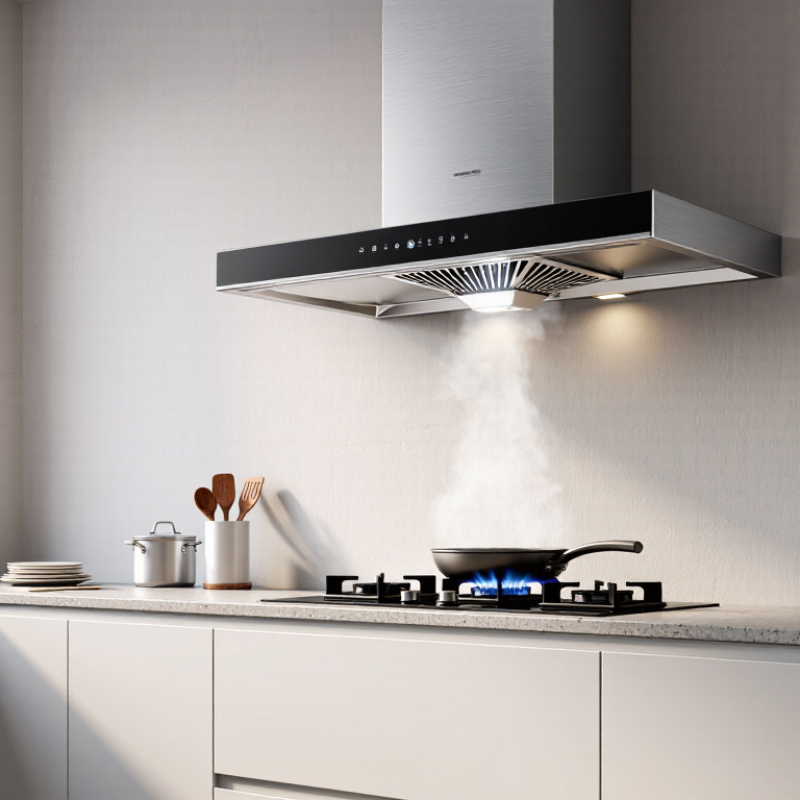
Table of Contents [Hide]
What Is a Range Exhaust?
What Is a Range Exhaust?
A range exhaust is a mechanical system that removes cooking fumes from above a stove. It usually includes a canopy, grease filters, a fan, and an air outlet. When the fan runs, it captures steam, smoke, oil particles, heat, and cooking odors. A ducted system sends this air outdoors. A recirculating system passes air through filters and returns it indoors.
The common explanation is incomplete. A filter does not make polluted air disappear. It mainly traps grease, while an activated-carbon filter can reduce some odors. Fine particles may still remain, especially during frying or high-heat cooking. The U.S. Environmental Protection Agency reports that indoor pollutant levels can be two to five times higher than outdoor levels. Cooking is one important indoor source.
Airflow also matters. ASHRAE Standard 62.2-2022 lists 100 cubic feet per minute for intermittent kitchen exhaust and 25 cubic feet per minute for continuous operation. These figures are useful references, not universal guarantees. A weak fan, blocked filter, or poorly designed duct can reduce performance. I have found that people often judge a range exhaust by noise alone. That is unreliable. Quiet operation may feel comfortable, but capture depends on airflow, hood position, duct resistance, and cooking habits. Even a powerful unit can miss steam from a tall pot placed near the front burner.