-
PRODUCTS & SERVICESOptimized cooling solutions for modern data centersProducts & ServicesOptimized cooling solutions for modern data centers
-
CAPABILITIESAdvancing liquid cooling technologiesCapabilitiesAdvancing liquid cooling technologies
-
TechnologiesLiquid Cooling InnovationTechnologiesLiquid Cooling Innovation
-
RESOURCESLatest News & InformationResourcesLatest News & Information
-
ABOUTOur history, leadership and ownershipAboutOur history, leadership and ownership
-
CONTACTFacility locations and global operational footprint





10 Tips for Choosing the Right Mild Steel Plate
Choosing the right mild steel plate is rarely as simple as comparing price and thickness. A plate that looks suitable in a warehouse may fail under welding heat, repeated loading, moisture, or poor dimensional control. This guide presents ten practical tips for making a more dependable choice. It considers grade, thickness, width, surface condition, chemical composition, mechanical properties, weldability, corrosion exposure, certification, and supplier performance.
“Steel selection is a compromise between strength, toughness, weldability, and cost,” explains Dr. Harry Bhadeshia, a widely respected authority in physical metallurgy. His observation is useful because no single Mild Steel Plate performs best in every application. ASTM A36 may suit general fabrication, while an equivalent EN-grade plate may better match a project’s regional specification. Always check the required standard. Do not rely on a familiar grade name alone.
Details matter.
A mill certificate should confirm yield strength, tensile strength, chemical composition, heat number, and test results. Measure the plate, too. A stated 10-millimeter plate may show small dimensional variation, and that difference can affect fit-up during fabrication. Examine edges for cracks, laminations, and severe scaling. A bright surface is not proof of internal quality.
This guide also questions common buying habits. The cheapest plate can create higher costs through rework, rejected welds, or delayed installation. Yet an expensive grade is not automatically the correct one. Ask how the plate will be cut, formed, welded, transported, and exposed. Then compare verified evidence, not attractive promises. The final decision should be technically justified, traceable, and realistic for the project’s working conditions.
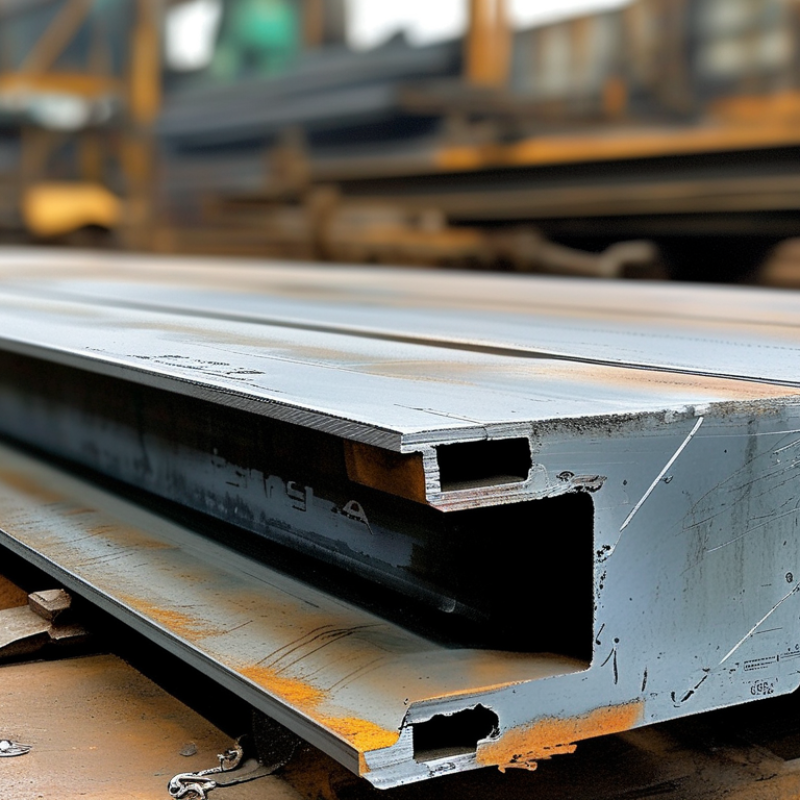
Table of Contents [Hide]
Understanding Mild Steel Plate Grades and Composition
Choosing the Right Mild Steel Plate
Mild steel plate usually contains about 0.05% to 0.25% carbon. This low carbon content improves weldability and makes cutting easier. Manganese adds strength, while small amounts of silicon and other elements support manufacturing performance. The exact balance depends on the grade and applicable standard.
Grade names are not interchangeable. A structural grade may suit frames, brackets, and general fabrication. A pressure-related grade may require tighter chemistry and testing. Thickness also affects yield strength, bending behavior, and heat treatment requirements. Check the material certificate, not only the sales description. It should state the grade, heat number, chemical composition, thickness, and test results.
Look for matching standards, such as ASTM, EN, or other recognized specifications. A plate marked “mild steel” alone provides too little information. Surface rust may be acceptable for some projects, but deep pitting reduces usable thickness. Inspect the edges and corners closely. Small cracks matter.
Welding changes the decision. High carbon or excessive residual elements can increase cracking risk. Ask for the carbon equivalent when welding thick plate or using restrained joints. In practice, a cheaper grade can create extra grinding, rework, or inspection costs. That trade-off is easy to overlook. I would also question vague certificates and inconsistent markings. They may indicate poor traceability, though not always. Verify dimensions with calipers, and confirm the grade against the design load before cutting.
10 Tips for Choosing the Right Mild Steel Plate - Understanding Mild Steel Plate Grades and Composition
| Tip | Typical Grade | Common Standard | Typical or Specification Chemistry, wt.% | Key Mechanical Information | Selection Guidance |
|---|---|---|---|---|---|
| 1 | ASTM A36 | ASTM A36/A36M | Carbon: up to 0.26 Manganese: commonly up to about 1.20 Phosphorus: up to 0.040 Sulfur: up to 0.050 | Minimum yield strength is commonly specified around 250 MPa, with thickness-related requirements. Tensile strength is typically 400–550 MPa. | Choose for general structural work, brackets, frames, base plates, and fabricated components where moderate strength and broad availability are important. |
| 2 | S235JR | EN 10025-2 | Carbon: up to about 0.17 Manganese: up to about 1.40 Phosphorus: up to 0.035 Sulfur: up to 0.035 | Minimum yield strength: 235 MPa for nominal thickness up to 16 mm. Tensile strength: approximately 360–510 MPa. | A suitable choice for ordinary structural fabrication, especially when European designations and impact-test requirements are used. |
| 3 | S275JR | EN 10025-2 | Carbon: up to about 0.21 Manganese: up to about 1.50 Phosphorus: up to 0.035 Sulfur: up to 0.035 | Minimum yield strength: 275 MPa for nominal thickness up to 16 mm. Tensile strength: approximately 410–560 MPa. | Consider when a higher yield strength than S235 is needed without moving to a highly alloyed steel. |
| 4 | S355JR | EN 10025-2 | Carbon: up to about 0.24 Manganese: up to about 1.60 Phosphorus: up to 0.035 Sulfur: up to 0.035 | Minimum yield strength: 355 MPa for nominal thickness up to 16 mm. Tensile strength: approximately 470–630 MPa. | Use for heavier structural loads, machinery supports, platforms, and frames where strength and weight reduction are priorities. |
| 5 | SAE/AISI 1018 | SAE J403 | Carbon: approximately 0.15–0.20 Manganese: approximately 0.60–0.90 Phosphorus: up to 0.040 Sulfur: up to 0.050 | Low-carbon steel with good machinability and weldability. Mechanical values vary substantially with product form and processing. | Select when machining, forming, and welding are more important than high structural strength. Confirm whether plate-form supply is available. |
| 6 | Low-Carbon Structural Plate | Applicable national or project standard | Carbon is generally kept below about 0.25 for good weldability. Manganese is commonly used for strength and deoxidation; phosphorus and sulfur are controlled as residual elements. | Lower carbon content generally improves weldability and reduces the risk of heat-affected-zone hardening. | Prioritize a low-carbon composition when the plate will be extensively welded, bent, formed, or repaired in the field. |
| 7 | Normalized or TMCP Plate | Specified by product standard | Chemistry is controlled together with rolling or heat-treatment conditions. Grain refinement may be achieved through niobium, vanadium, or titanium microalloying in small quantities. | Normalized or thermomechanically controlled plates can provide a more consistent strength and toughness balance than basic as-rolled material. | Choose the delivery condition when toughness, thickness uniformity, weld performance, or reduced structural weight is important. |
| 8 | Impact-Tested Grade | JR, J0, or J2 designation under EN 10025-2 | The principal chemistry may be similar across grades, but impact-test temperature requirements differ. JR is tested at +20°C, J0 at 0°C, and J2 at −20°C. | Impact toughness indicates resistance to brittle fracture at a specified test temperature; it is not the same as yield strength. | Specify the appropriate impact class for cold environments, dynamic loading, outdoor structures, or safety-critical fabrication. |
| 9 | Pickled and Oiled Plate | Finish requirement added to the steel grade | The steel chemistry remains that of the selected grade. Pickling removes mill scale; oiling provides temporary corrosion protection during storage and transport. | Surface condition is improved compared with ordinary hot-rolled scale, but the oil coating is not a permanent corrosion-protection system. | Select this finish for painting, laser cutting, forming, or applications where a cleaner and more uniform surface is beneficial. |
| 10 | Certified Plate | Mill test certificate required | Confirm actual heat analysis for carbon, manganese, silicon, phosphorus, sulfur, and any specified microalloying or residual elements. | Verify actual yield strength, tensile strength, elongation, impact results where applicable, dimensional tolerances, and delivery condition. | Match the purchase certificate to the design standard and thickness. Do not rely on a grade name alone when welding, pressure, lifting, or safety requirements apply. |
Note: Chemical limits and mechanical properties can vary with thickness, product standard, delivery condition, and edition of the specification. Always verify the current standard and the mill test certificate before production or safety-critical use.