-
PRODUCTS & SERVICESOptimized cooling solutions for modern data centersProducts & ServicesOptimized cooling solutions for modern data centers
-
CAPABILITIESAdvancing liquid cooling technologiesCapabilitiesAdvancing liquid cooling technologies
-
TechnologiesLiquid Cooling InnovationTechnologiesLiquid Cooling Innovation
-
RESOURCESLatest News & InformationResourcesLatest News & Information
-
ABOUTOur history, leadership and ownershipAboutOur history, leadership and ownership
-
CONTACTFacility locations and global operational footprint







Top 10 Multi Hole Drilling Machines for Global Buyers
Choosing a Multi Hole Drilling Machine is less about counting spindles than matching the machine to real production. A cabinet shop may need evenly spaced holes across long panels, while a furniture plant may prioritize fast changeovers between batches. Feed accuracy, spindle layout, workpiece clamping, and service access all matter. Small differences show up on the shop floor.
The International Federation of Robotics’ World Robotics 2024 report recorded about 4.28 million industrial robots operating in factories worldwide in 2023, a 10% increase from 2022. This is not a drilling-machine sales figure. It does show how automation is reshaping manufacturing, where repeatability and integration increasingly matter. Taiichi Ohno’s often-cited principle, “Without standards, there can be no improvement,” offers a useful lens: buyers should compare measurable output, setup time, and hole-position consistency, not just headline speed.
Still, a catalog rarely tells the whole story. Ask for a trial using your panel material, thickness, and hole pattern. Watch the operator load a panel, change a setting, and clear a finished part. These details reveal practical strengths—and awkward compromises—that specifications may miss. The following selection of ten machines is intended as a starting point for global buyers. Compare each model against your throughput, support needs, and factory layout; no single machine fits every line.
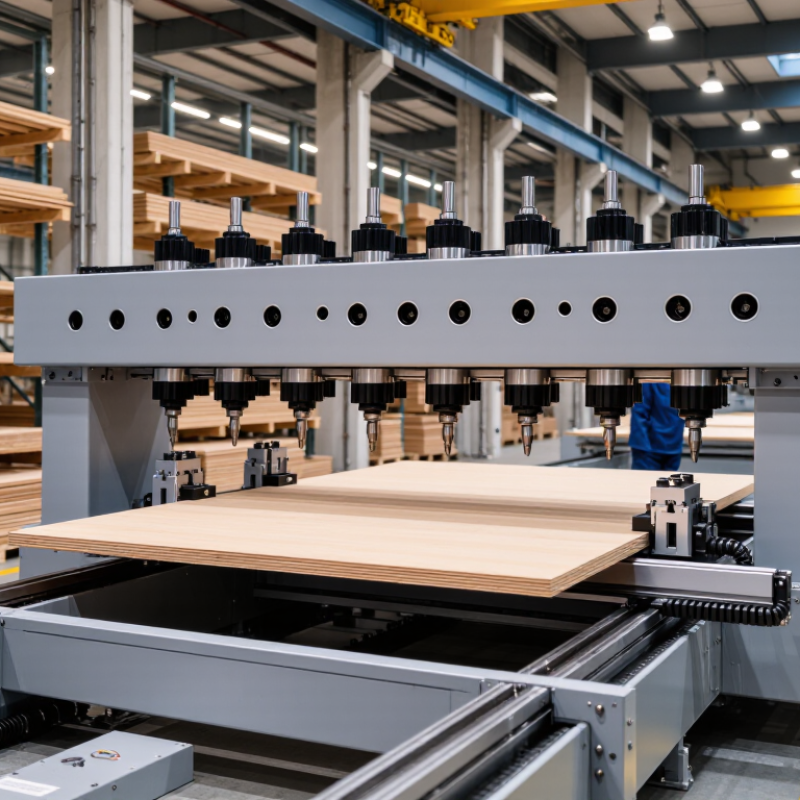
Table of Contents [Hide]
Understanding Multi-Hole Drilling Machines and Their Main Types
Understanding Multi-Hole Drilling Machines and Their Main Types
A multi-hole drilling machine creates several holes in one setup, helping shops repeat a defined hole pattern across many parts. The term covers different layouts, not one universal design. Some machines use a multi-spindle head, where several drills work at once. Others use gang drilling: separate drilling heads sit in a row, and the workpiece moves between stations. That arrangement can suit parts needing different hole sizes or operations. Fast, but setup matters.
CNC multi-head machines use programmed movement to position drilling units or the workpiece. They can handle changing patterns with less manual repositioning, though programming and fixturing still require care. Dedicated machines are often built around one component or hole layout, such as a panel with evenly spaced mounting holes. They may be highly productive, but less adaptable when designs change.
Choosing a type starts with the part. Check hole spacing, diameter, material, production volume, and required accuracy. A steel plate may need a rigid fixture and controlled feed; a thin panel can shift or distort under pressure. Look closely at chip clearance and spindle spacing, too. A tidy drawing does not guarantee easy machining. Operators sometimes discover that a clamp blocks a drill only after the first setup, so a test piece is worth the time.