-
PRODUCTS & SERVICESOptimized cooling solutions for modern data centersProducts & ServicesOptimized cooling solutions for modern data centers
-
CAPABILITIESAdvancing liquid cooling technologiesCapabilitiesAdvancing liquid cooling technologies
-
TechnologiesLiquid Cooling InnovationTechnologiesLiquid Cooling Innovation
-
RESOURCESLatest News & InformationResourcesLatest News & Information
-
ABOUTOur history, leadership and ownershipAboutOur history, leadership and ownership
-
CONTACTFacility locations and global operational footprint







China Top Fuel Cell Hydrogen Station Manufacturers?
China has become a major manufacturing base for hydrogen refueling infrastructure. Its suppliers serve buses, trucks, logistics fleets, and emerging passenger-vehicle projects. Yet “top” does not simply mean the lowest quoted price. A dependable Fuel Cell Hydrogen Station must deliver stable pressure, accurate metering, clean hydrogen, and safe daily operation.
Dr. Sunita Satyapal, former director of the U.S. Department of Energy’s Hydrogen and Fuel Cell Technologies Office, described hydrogen as “a versatile energy carrier that can be produced from diverse domestic resources.” Her statement reflects the industry’s broader challenge. Station builders must connect production, compression, storage, dispensing, monitoring, and maintenance into one working system. Small weaknesses can become costly delays. A dispenser may look modern, while its cooling system struggles during repeated heavy-duty refueling.
This guide examines China’s leading Fuel Cell Hydrogen Station manufacturers through practical criteria. These include engineering experience, equipment integration, hydrogen purity control, pressure capability, certification support, remote monitoring, and after-sales service. Factory testing matters. So does the supplier’s response when a valve fails on a winter morning.
Manufacturer rankings can be imperfect. Public data is often incomplete. Some companies disclose impressive projects but provide limited uptime evidence. Buyers should request operating records, maintenance schedules, component origins, and references from comparable stations. A strong supplier should explain its limitations clearly.
China’s market offers competitive technology and expanding production capacity. However, reliable deployment requires more than equipment delivery. It requires transparent specifications, trained technicians, documented safety procedures, and long-term technical support. This overview aims to separate measurable capability from attractive marketing language.
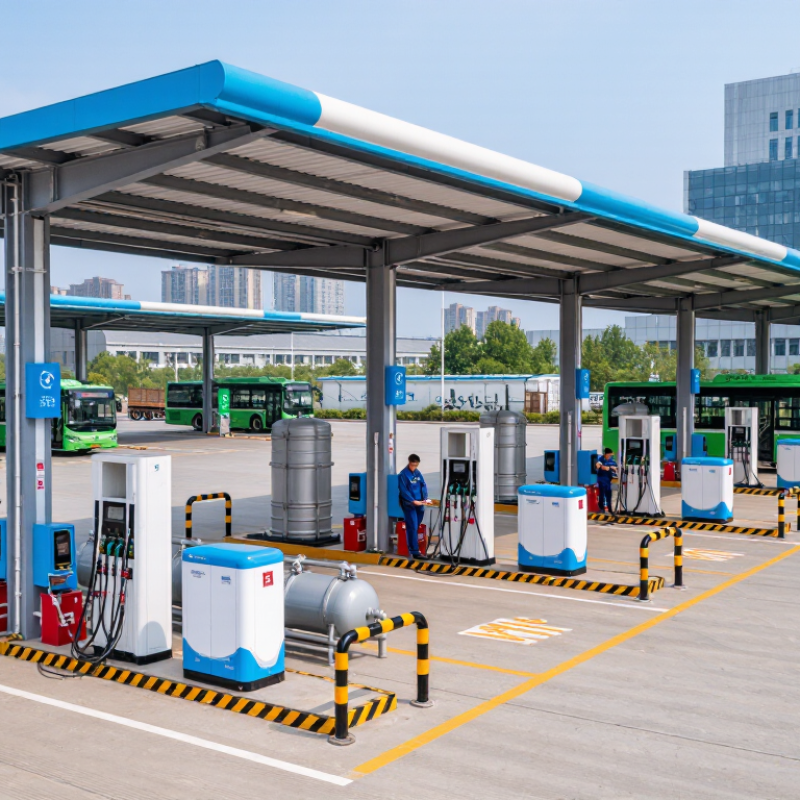
Table of Contents [Hide]
Definition and Role of Fuel Cell Hydrogen Stations in China
Fuel cell hydrogen stations are specialized facilities that produce, receive, compress, store, and dispense hydrogen for fuel cell vehicles. In China, they support cleaner transport in buses, logistics fleets, heavy trucks, and selected passenger applications. Unlike conventional fuel stations, they require high-pressure equipment, precise cooling systems, leak detection, and controlled dispensing procedures.
A reliable station depends on more than its visible dispensers. Operators must verify hydrogen purity, pressure stability, emergency shutdown systems, ventilation, and equipment maintenance records. Local traffic patterns also matter. A station near a fleet depot may achieve better daily utilization than one built only for occasional private vehicles. In practice, some projects look technologically advanced but deliver limited value when demand forecasts are weak. This remains an important industry lesson.
Tips: Compare suppliers by safety documentation, testing capability, maintenance response, and experience with local operating conditions. Ask for clear evidence of pressure-cycle testing and hydrogen quality control. Do not judge a station by capacity alone. A smaller facility may perform better when its supply chain is stable and its operators are well trained. China’s market is developing quickly, yet standards, costs, and utilization assumptions still require careful review. Mistakes are possible. Independent technical assessment can expose them early.
China Top Fuel Cell Hydrogen Station Manufacturers? - Definition and Role of Fuel Cell Hydrogen Stations in China
| Data Dimension | Industry Definition or Technical Data | Typical Application in China | Role in the Fuel Cell Hydrogen Value Chain | Relevant Technical Reference |
|---|---|---|---|---|
| Station Definition | A hydrogen refueling station is a facility that receives, produces, compresses, stores, meters, and dispenses hydrogen to fuel-cell vehicles. | Used for buses, heavy-duty trucks, logistics vehicles, passenger vehicles, and other road vehicles powered by hydrogen fuel cells. | Connects hydrogen production and distribution infrastructure with transportation users. | China’s national technical framework for hydrogen refueling stations and fuel-cell vehicles. |
| Hydrogen Supply Mode | Hydrogen may be supplied by tube trailers, liquid-hydrogen transport, pipelines, or produced on site by electrolysis or other reforming processes. | Delivered gaseous hydrogen is widely used where centralized hydrogen production is available; on-site production can reduce transport distance. | Determines station layout, storage requirements, operating cost, and supply reliability. | Hydrogen supply is selected according to local industrial resources, transport distance, land availability, and vehicle demand. |
| Common Vehicle Pressure | 35 MPa refueling is commonly associated with buses and many commercial vehicles, while 70 MPa refueling is used for passenger vehicles and selected light-duty applications. | Commercial fleets in China often prioritize 35 MPa systems because of vehicle size, operating routes, and fleet-oriented station design. | Pressure selection affects compressor specifications, storage cascade design, dispenser configuration, and vehicle compatibility. | Fuel-cell vehicle and hydrogen refueling-station standards distinguish pressure classes for different vehicle applications. |
| Hydrogen Quality | Hydrogen supplied to fuel-cell vehicles must meet fuel-cell-grade purity and contaminant limits. ISO 14687:2019 specifies Grade D hydrogen for road-vehicle fuel-cell applications, including a minimum hydrogen purity of 99.97% by volume. | Purity control is required for both delivered hydrogen and hydrogen produced by on-site equipment. | Prevents catalyst poisoning, protects stack performance, and supports vehicle durability. | ISO 14687:2019 and China’s fuel-cell vehicle hydrogen-fuel specification framework. |
| Main Process Equipment | Typical equipment includes unloading or production units, compressors, high-pressure storage vessels, priority panels, dispensers, cooling systems, valves, meters, leak detectors, and control systems. | Equipment combinations vary according to the supply mode, target vehicle pressure, station capacity, and site restrictions. | Controls the complete sequence from hydrogen reception or production to safe vehicle refueling. | Equipment should be selected and integrated in accordance with applicable safety, pressure-vessel, metering, and electrical standards. |
| Compression Function | Compressors raise hydrogen from the supply pressure to the pressure required for high-pressure storage and vehicle dispensing. | Reciprocating, diaphragm, hydraulic, and other compressor technologies may be used depending on throughput, inlet pressure, and maintenance requirements. | Compression is essential for achieving efficient storage and rapid refueling. | Compressor selection depends on hydrogen flow rate, pressure ratio, duty cycle, vibration control, and hydrogen compatibility. |
| High-Pressure Storage | High-pressure storage is normally arranged in multiple banks or cascades so that hydrogen can be transferred efficiently during dispensing. | Storage capacity is designed around peak vehicle demand, delivery intervals, compressor performance, and available site area. | Balances supply and demand and reduces the time required for vehicle refueling. | Storage vessels and piping must comply with applicable pressure-equipment and hydrogen-service safety requirements. |
| Pre-Cooling | High-pressure hydrogen dispensing may require pre-cooling to control gas temperature during rapid filling, particularly for 70 MPa applications. | Pre-cooling systems are more important where passenger vehicles or other rapid-refueling vehicles are served. | Supports safe filling, protects vehicle components, and helps maintain the required filling protocol. | Hydrogen refueling protocols specify temperature, pressure, communication, and filling-control requirements. |
| Refueling Time | Refueling time depends on vehicle tank capacity, starting pressure, station capacity, dispenser configuration, ambient temperature, and filling protocol. | Fleet stations are commonly designed around scheduled operation and vehicle queuing, while passenger-vehicle stations require faster and more standardized dispensing. | Directly affects fleet productivity, station utilization, and the number of vehicles a station can serve per day. | Actual filling time must be verified through the selected vehicle and station design rather than assumed from pressure alone. |
| On-Site Electrolysis | Electrolyzers split water into hydrogen and oxygen by using electricity. The hydrogen is then dried, purified, compressed, and stored or dispensed. | Suitable for locations with access to electricity, water, renewable power, or distributed hydrogen demand. | Can reduce dependence on long-distance hydrogen delivery and connect station operation with renewable-energy utilization. | System performance depends on electrolyzer type, electricity source, water treatment, operating hours, and compression requirements. |
| Station Safety | Safety systems commonly include hydrogen leak detection, ventilation, emergency shut-off, pressure relief, grounding, fire protection, separation distances, and controlled access. | Safety design is required for both standalone stations and integrated stations located near industrial, commercial, or transport facilities. | Reduces the probability and consequence of leakage, overpressure, ignition, and equipment failure. | Station design should follow Chinese fire-safety, hazardous-chemical, pressure-equipment, electrical, and hydrogen-specific requirements. |
| Automation and Monitoring | Modern stations use sensors, programmable control systems, gas-quality monitoring, pressure and temperature monitoring, metering, alarms, and remote operating functions. | Digital monitoring is increasingly used for fleet scheduling, maintenance planning, fault diagnosis, and operational data management. | Improves safety, availability, traceability, and lifecycle maintenance efficiency. | Control architecture should include fail-safe logic, alarm management, data recording, and emergency shutdown functions. |
| Station Layout Types | Common configurations include external-hydrogen stations, on-site production stations, and combined stations that integrate hydrogen production with refueling. | External-hydrogen stations are practical near centralized supply; integrated stations are suitable where local production and demand are closely matched. | Layout selection affects permitting, logistics, capital expenditure, land use, and station operating flexibility. | Site selection must consider hydrogen source, transport routes, vehicle demand, safety distances, utilities, and local approval requirements. |
| Primary User Segment | Fuel-cell buses and heavy-duty vehicles generally create predictable, concentrated hydrogen demand along fixed routes or logistics corridors. | Commercial fleets are important early users because centralized depot operation can improve station utilization. | Stable fleet demand supports station economics and helps establish regional hydrogen transportation networks. | Demand assessment should use vehicle routes, daily mileage, tank capacity, refueling frequency, and operating schedules. |
| Key Selection Criteria | Important criteria include hydrogen source, purity, pressure class, daily throughput, peak-hour demand, compressor reliability, safety compliance, land area, and lifecycle cost. | Buyers typically evaluate complete system integration rather than an individual component alone. | Provides a practical framework for comparing hydrogen-station engineering and equipment suppliers without relying on company or brand names. | Technical evaluation should be based on verified specifications, certification, commissioning records, maintenance capability, and compliance documentation. |
Reference note: The technical descriptions above are based on generally accepted hydrogen-refueling practices and publicly available standards, including ISO 14687:2019 and China’s national standards covering hydrogen fuel for fuel-cell vehicles, hydrogen refueling stations, pressure equipment, metering, and safety management. Actual station parameters must be confirmed through the approved engineering design, vehicle specifications, local regulations, and site conditions.