-
PRODUCTS & SERVICESOptimized cooling solutions for modern data centersProducts & ServicesOptimized cooling solutions for modern data centers
-
CAPABILITIESAdvancing liquid cooling technologiesCapabilitiesAdvancing liquid cooling technologies
-
TechnologiesLiquid Cooling InnovationTechnologiesLiquid Cooling Innovation
-
RESOURCESLatest News & InformationResourcesLatest News & Information
-
ABOUTOur history, leadership and ownershipAboutOur history, leadership and ownership
-
CONTACTFacility locations and global operational footprint






Who Are the Top Shower Glass Manufacturers in China?
China has become a major manufacturing base for bathroom and architectural glass products. Its advantages include strong processing capacity, integrated supply chains, and competitive export logistics. For buyers, however, factory scale alone does not prove reliable performance. Glass quality, hardware precision, safety testing, and after-sales support matter equally.
Industry data supports this growing opportunity. Fortune Business Insights’ Shower Enclosures Market report identifies renovation activity, urban housing, and premium bathroom upgrades as important demand drivers. Grand View Research’s Bathroom Furniture Market Size, Share & Trends Analysis Report also highlights continued growth in modern bathroom solutions through 2030. These reports do not rank individual Chinese suppliers, but they explain why the country has attracted global attention. The market is expanding. Supplier selection is becoming more demanding.
This guide examines who the top Shower Glass manufacturers in China may be and how their capabilities compare. The review considers tempered glass production, laminated options, CNC edge processing, enclosure design, hardware compatibility, customization, and export experience. Compliance evidence deserves close attention. Buyers should request test records related to China’s GB 15763.2 standard, EN 12150, or ANSI Z97.1, depending on the destination market. ISO 9001 certification can support process control, but it is not a substitute for product testing.
A ranking can never be perfect. Some factory claims still need checking. Factory visits, sample inspections, and documented quality procedures provide stronger evidence than polished websites. Details matter: a clean edge, consistent thickness, accurate drilling, and a door that closes smoothly. This article therefore focuses on practical verification, not promotional promises, helping distributors, contractors, and project owners identify manufacturers with credible technical and commercial strengths.
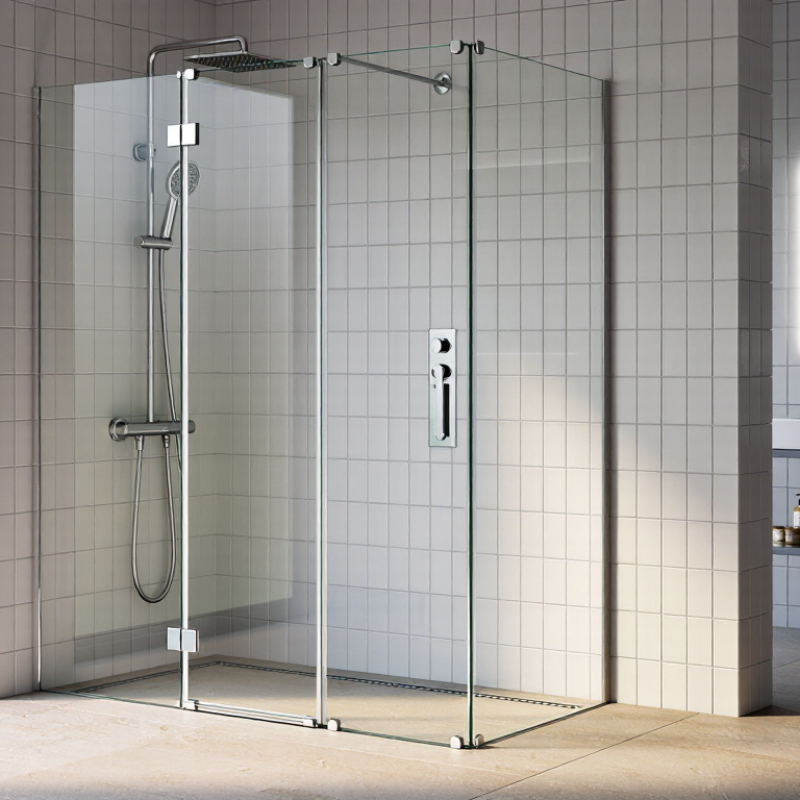
Table of Contents [Hide]
What Defines a Leading Shower Glass Manufacturer in China?
A leading shower glass manufacturer in China is defined by controlled quality, not factory size alone. Fortune Business Insights valued the global shower enclosure market at about USD 4.46 billion in 2023 and projects continued growth through 2032. This expansion raises buyer expectations. Manufacturers must provide stable glass thickness, accurate edge polishing, and repeatable drilling. Tempered safety glass should meet recognized requirements, such as EN 12150 or ANSI Z97.1, depending on the destination market. Documentation matters.
Look beyond polished samples. Ask for heat-soak testing records, batch traceability, and inspection reports from independent laboratories. A reliable supplier should explain how it checks nickel sulfide risks, coating adhesion, hardware corrosion, and dimensional tolerance. This is where practical experience becomes visible. Doors should open smoothly. Seals should sit evenly. Small gaps can become large complaints after installation. According to Grand View Research, premium design and renovation demand are supporting growth in the shower enclosure sector, making customization increasingly important. However, customization without engineering control creates waste and delays. That deserves attention.
Communication is another defining measure. A capable manufacturer confirms drawings, packaging details, glass orientation, and replacement procedures before production. It should also disclose limitations instead of promising everything. No factory is perfect. Even strong quality systems need review after transport damage, installation errors, or changing project specifications. Buyers should compare corrective-action records, not only prices. That evidence often reveals the real manufacturing standard.
Who Are the Top Shower Glass Manufacturers in China? - What Defines a Leading Shower Glass Manufacturer in China?
| Evaluation Dimension | Relevant Industry Benchmark | Why It Matters | Recommended Verification |
|---|---|---|---|
| Glass Safety Type | Heat-treated safety glass, normally tempered rather than ordinary annealed glass. | Tempered glass is designed to break into smaller, relatively less sharp fragments than ordinary glass when it fails. | Request product certificates, heat-treatment records, and independent test reports for the actual production site. |
| Common Glass Thickness | Approximately 6 mm, 8 mm, or 10 mm for many frameless and semi-frameless shower applications, subject to design and local code. | Thickness affects panel stiffness, weight, hardware compatibility, handling requirements, and perceived quality. | Confirm thickness tolerance, panel dimensions, maximum size limits, and compatibility with the selected hardware system. |
| Applicable Safety Standards | Depending on the destination market: ANSI Z97.1, CPSC 16 CFR 1201, EN 12150, or other applicable national requirements. | Standards establish safety, impact-resistance, fragmentation, marking, or conformity requirements. | Check the standard edition, test scope, laboratory identity, certificate validity, and whether the report covers the exact glass specification. |
| Dimensional Accuracy | Production should follow approved drawings and agreed tolerances for height, width, hole position, edgework, and squareness. | Accurate panels reduce installation problems, water leakage, alignment issues, and on-site rework. | Use a signed technical drawing, first-article inspection, calibrated measuring tools, and documented final inspection reports. |
| Edge and Surface Processing | Edges should be properly polished or finished; surfaces should be free from visible chips, deep scratches, cracks, and unacceptable distortion. | Correct processing improves handling safety, appearance, installation fit, and resistance to edge-related damage. | Approve physical samples and define defect limits for edge chips, scratches, roller marks, optical distortion, and coating blemishes. |
| Hole and Cut-Out Quality | Hole diameter, location, spacing, and edge distance must match the approved hardware drawing before tempering. | Glass generally cannot be drilled or cut after tempering, making pre-processing accuracy critical. | Verify CNC or drilling capability, use dimensional inspection records, and test-fit representative panels with the actual hardware. |
| Tempering Process Control | A controlled heating and rapid-cooling process with traceable batch records and documented inspection procedures. | Consistent processing helps control strength, fragmentation behavior, optical quality, and breakage risk. | Audit furnace records, batch identification, thermocouple or process-monitoring methods, and fragmentation test results. |
| Glass Appearance Options | Clear, low-iron, frosted, patterned, tinted, laminated, and coated options are commonly available, depending on the production line. | Different finishes affect privacy, light transmission, cleaning, aesthetics, and project positioning. | Compare approved samples under consistent lighting and confirm coating durability, color tolerance, and cleaning instructions. |
| Hardware Compatibility | Panel dimensions, thickness, holes, notches, edgework, hinges, seals, and support conditions must be engineered as one system. | A high-quality glass panel can still fail to perform if the hardware design or installation interface is unsuitable. | Require coordinated shop drawings, load calculations where necessary, installation manuals, and prototype assembly checks. |
| Quality Management | A documented quality system with incoming inspection, process inspection, final inspection, corrective action, and traceability. | Systematic controls are more reliable than visual inspection performed only before shipment. | Review quality manuals, inspection forms, calibration certificates, nonconformance records, and corrective-action history. |
| Packaging and Transit Protection | Purpose-built crates, separators, edge protection, moisture control, shock prevention, and clear handling labels. | Shower glass is vulnerable to edge damage, impact, vibration, and improper loading during transportation. | Inspect packaging specifications, loading photographs, crate test procedures, and claims-handling arrangements. |
| Customization Capability | Capability to produce made-to-measure panels, special shapes, holes, notches, surface treatments, and project-specific packaging. | Custom capability is essential for bathroom layouts with non-standard dimensions or architectural requirements. | Request samples of comparable projects, production lead times, minimum order quantities, and drawing approval procedures. |
| Export and Compliance Documentation | Commercial invoices, packing lists, certificates of origin when required, test reports, product markings, and destination-market documents. | Complete documentation reduces customs delays, installation disputes, and compliance risks. | Confirm document templates before production and ensure product descriptions, quantities, specifications, and marks are consistent. |
| After-Sales Support | Clear warranty terms, replacement procedures, technical support, installation guidance, and response-time commitments. | Reliable support is important because glass damage, measurement changes, and installation questions may arise after delivery. | Review warranty exclusions, spare-part policies, escalation contacts, service records, and the process for handling breakage claims. |
Note: Applicable glass thickness, safety requirements, tolerances, and testing obligations should be confirmed against the destination market, project design, local building regulations, and the final hardware system.