-
PRODUCTS & SERVICESOptimized cooling solutions for modern data centersProducts & ServicesOptimized cooling solutions for modern data centers
-
CAPABILITIESAdvancing liquid cooling technologiesCapabilitiesAdvancing liquid cooling technologies
-
TechnologiesLiquid Cooling InnovationTechnologiesLiquid Cooling Innovation
-
RESOURCESLatest News & InformationResourcesLatest News & Information
-
ABOUTOur history, leadership and ownershipAboutOur history, leadership and ownership
-
CONTACTFacility locations and global operational footprint




What Is a Pallet Conveyor and How Does It Work?
A Pallet Conveyor is a powered material-handling system designed to move loaded pallets through warehouses, factories, and distribution centers. It uses rollers, chains, motors, sensors, and control software to transport heavy loads along a planned route. Some systems move pallets continuously. Others stop, release, or accumulate them at specific stations.
Richard Muther, a respected authority on plant layout and material handling, stated, “The best material handling is no handling.” This principle explains why a well-designed Pallet Conveyor should reduce unnecessary movement, waiting, lifting, and manual intervention. It should not simply move pallets faster. It should move them safely, accurately, and at the right time.
Inside a typical system, sensors detect pallet position and communicate with a programmable logic controller. The controller starts, stops, diverts, or merges pallet flow. Roller conveyors suit many stable loads, while chain conveyors can handle pallets with uneven undersides. Transfers may turn pallets ninety degrees or shift them between conveyor lines.
The details matter.
A small mismatch in pallet dimensions can cause jams. Poor sensor placement can create gaps or unexpected stops. An oversized motor may waste energy, while an undersized one may struggle under peak loads. These practical weaknesses deserve attention.
This guide explains what a Pallet Conveyor is, how its main components work, and where different designs perform best. It also considers maintenance, safety, load stability, and layout planning. The goal is not to present one perfect solution. Real facilities have constraints, and good conveyor design begins by acknowledging them.
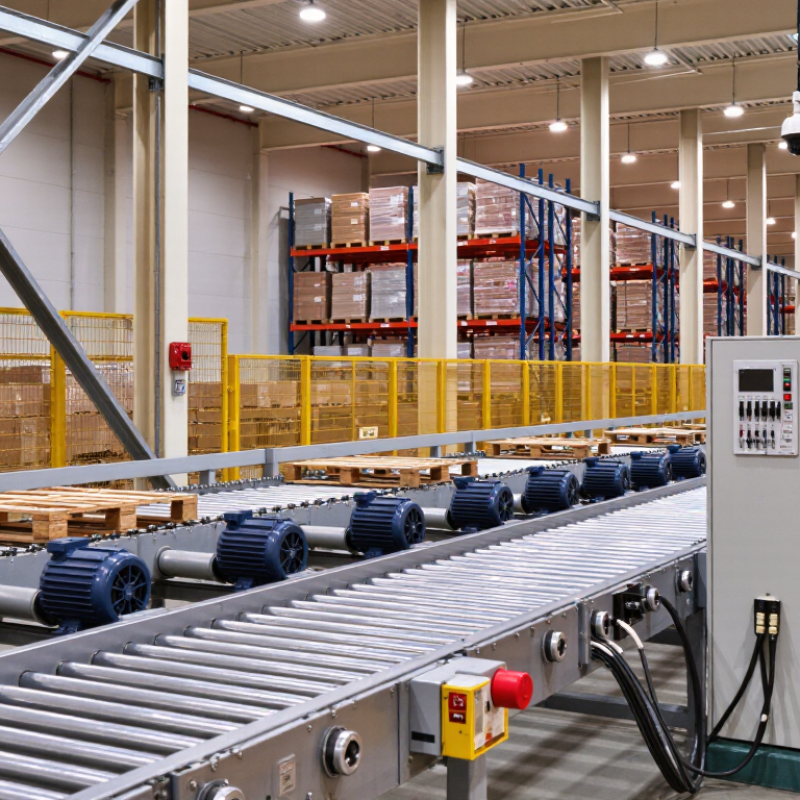
Table of Contents [Hide]
What Is a Pallet Conveyor?
A pallet conveyor is a powered material-handling system that moves loaded pallets through a warehouse, factory, or distribution center. It uses rollers, chains, belts, or a combination of these components. Each pallet travels along a planned route, often between storage areas, picking stations, and loading docks. The conveyor frame supports the load, while motors and sensors control movement, spacing, and stopping points.
The working process is practical. A pallet enters through a loading zone and passes sensors that confirm its position. Drive rollers or chains then move it forward at a controlled speed. At a transfer point, a lift, turntable, or chain transfer changes its direction. Operators can connect the system with warehouse software, but software alone cannot correct poor pallet quality. Bent boards, uneven loads, and loose wrapping still cause jams.
Reliable figures support this growing role. The 2024 MHI Annual Industry Report states that 55% of surveyed supply chain professionals planned to increase investment in automation and robotics. Interact Analysis also reported that global warehouse automation revenue was expected to exceed 30 billion dollars by 2027. These figures suggest strong demand, not guaranteed success. A conveyor may improve throughput, yet an unsuitable layout can create new bottlenecks. In field evaluations, checking pallet dimensions, load weight, emergency access, and maintenance space should come before selecting equipment. Small details matter.