-
PRODUCTS & SERVICESOptimized cooling solutions for modern data centersProducts & ServicesOptimized cooling solutions for modern data centers
-
CAPABILITIESAdvancing liquid cooling technologiesCapabilitiesAdvancing liquid cooling technologies
-
TechnologiesLiquid Cooling InnovationTechnologiesLiquid Cooling Innovation
-
RESOURCESLatest News & InformationResourcesLatest News & Information
-
ABOUTOur history, leadership and ownershipAboutOur history, leadership and ownership
-
CONTACTFacility locations and global operational footprint



Why Do Buyers Choose HDPE Welding Equipment?
Buyers choose Hdpe Welding Equipment because a pipeline’s weakest point can be its joint. A sound fusion process helps create continuous connections in water, wastewater, gas, and industrial piping. It also reduces reliance on separate fittings at each connection. Yet equipment alone cannot guarantee a sound weld. Preparation, operator skill, and controlled conditions matter just as much.
The scale of infrastructure investment helps explain the demand. The U.S. Environmental Protection Agency’s 2023 Drinking Water Infrastructure Needs Survey and Assessment estimated $625 billion in drinking-water infrastructure needs over 20 years. That figure is not a sales forecast for welding machines. It does, however, show the importance of dependable pipe installation and repair. The Plastics Pipe Institute’s Handbook of PE Pipe and ASTM F2620 provide technical guidance on polyethylene pipe and heat-fusion practices. Buyers can use these references when comparing machine controls, data recording, portability, and support.
As a practical takeaway from fusion specialist guidance: “Consistent heat, pressure, and timing are the foundation of a reliable fusion joint.” Treat that as a principle, not a substitute for a verified source or procedure. On a jobsite, a readable temperature display and a stable clamp can matter more than a long feature list. A machine that records weld parameters may also help supervisors review work later. Still, the best equipment depends on pipe size, site conditions, and crew experience. Buyers sometimes overvalue automation. That deserves a second look. A capable machine is useful; a trained operator makes it count.
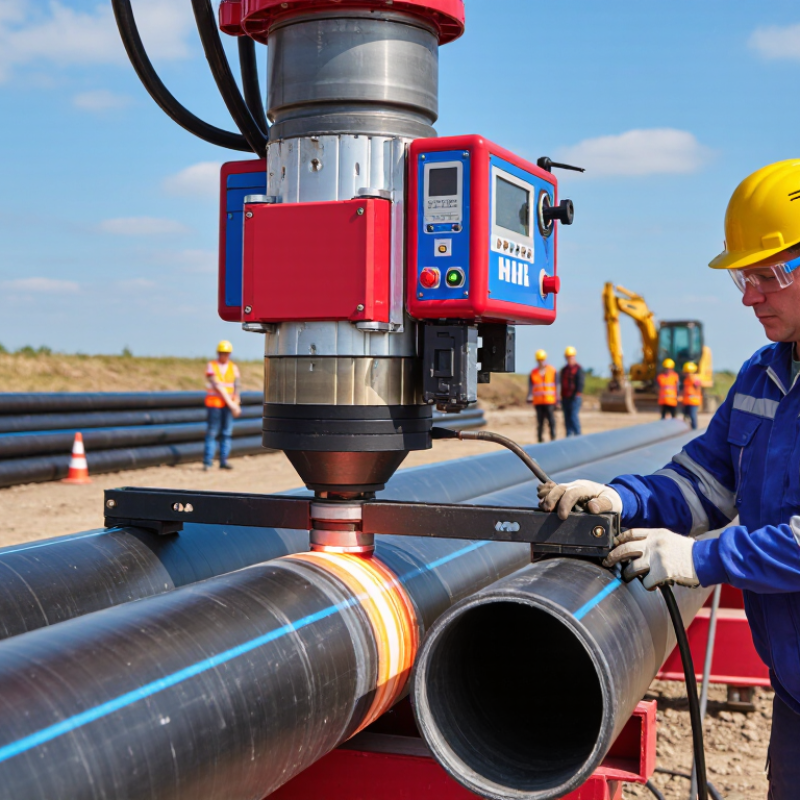
Table of Contents [Hide]
What HDPE Welding Equipment Is and How It Works
HDPE welding equipment joins high-density polyethylene pipes and fittings by softening their surfaces and pressing them together. Common systems include butt-fusion machines, electrofusion tools, and extrusion welders. Each serves different joint shapes and site conditions. No single setup fits every job.
A butt-fusion machine holds two pipe ends in aligned clamps. A facing tool trims them flat, then a heated plate warms the ends. The plate is removed, and controlled pressure brings the softened surfaces together. The joint cools while held in place. Keep it steady.
Electrofusion works differently. A fitting contains a heating coil, and a control unit sends a measured electrical current through it. The coil melts the contact surfaces, forming a fused joint as the plastic cools. Operators need clean, dry surfaces and accurate pipe preparation; dirt or poor alignment can weaken a connection. Small details matter.
In practice, crews check the pipe size, wall thickness, and machine settings before welding. They also allow the joint to cool for the specified time. Rushing is tempting on a busy site, but it can undo careful preparation. Even experienced operators should inspect the finished bead or fitting and record key process details. Equipment helps control the work, though it cannot correct every mistake.
Why Do Buyers Choose HDPE Welding Equipment? — What It Is and How It Works
| Topic | What It Means | How It Works | Why Buyers Value It |
|---|---|---|---|
| HDPE welding equipment | Tools and machines used to join high-density polyethylene pipes, fittings, or sheets. | Equipment heats compatible HDPE surfaces and applies controlled pressure so the softened material forms a fused joint as it cools. | It creates a continuous joint without relying on a separate mechanical connector at the weld. |
| Butt fusion | A common joining method for compatible thermoplastic pipes and fittings with matching outside diameters. | The pipe ends are aligned and faced, heated with a hot plate, then pressed together under specified conditions and allowed to cool. | It can produce a full-bore joint suitable for many water, gas, and industrial piping applications when installed to the applicable standard. |
| Electrofusion | A joining method that uses a fitting containing an embedded electrical resistance element. | An electrofusion control unit supplies the specified electrical energy to the fitting, heating its inner surface and the pipe’s outer surface. | It is useful where access, space, or pipe geometry makes butt fusion impractical, provided the joint is prepared and fused correctly. |
| Socket fusion | A method often used for smaller-diameter pipes and fittings. | A heated tool warms the pipe end and fitting socket; the parts are then assembled to the required insertion depth and left undisturbed to cool. | Its compact equipment can be practical for smaller piping systems and confined work areas. |
| Temperature control | Management of the heating surface temperature during the fusion process. | Heaters bring the joining surfaces to the process temperature specified by the relevant procedure and equipment instructions. | Consistent heating helps avoid underheating or overheating, both of which can compromise joint quality. |
| Alignment and clamping | Holding pipe or fitting components in the correct position during preparation and joining. | Clamps secure the components while the ends are faced, heated, brought together, or fused. | Good alignment helps reduce uneven contact and stress at the joint. |
| Fusion pressure and timing | Controlled force and process intervals used during joining. | The operator or control system follows a qualified procedure that defines relevant pressure, heating, joining, and cooling steps. | Repeatable process control supports more consistent results across multiple joints. |
| Joint cooling | The period during which a fused joint is kept stable while it cools. | The components remain supported and undisturbed for the cooling time specified by the applicable procedure. | Proper cooling helps the joint solidify before handling or loading. |
| Portability and job-site setup | Equipment size, power needs, and suitability for field conditions. | Machines may be selected according to pipe diameter, available power, work space, and the joining method required. | Choosing equipment suited to the site can make installation and transport more manageable. |
| Inspection and operator skill | Quality checks and competent use of the equipment. | Operators inspect prepared surfaces, machine condition, alignment, recorded parameters, and completed joints according to the project procedure. | Equipment alone cannot guarantee a sound weld; trained operators and suitable inspection practices are essential. |