-
PRODUCTS & SERVICESOptimized cooling solutions for modern data centersProducts & ServicesOptimized cooling solutions for modern data centers
-
CAPABILITIESAdvancing liquid cooling technologiesCapabilitiesAdvancing liquid cooling technologies
-
TechnologiesLiquid Cooling InnovationTechnologiesLiquid Cooling Innovation
-
RESOURCESLatest News & InformationResourcesLatest News & Information
-
ABOUTOur history, leadership and ownershipAboutOur history, leadership and ownership
-
CONTACTFacility locations and global operational footprint







Why Choose an Induction Soup Pot for Your Kitchen?
An Induction Soup Pot can turn a slow, uneven cooking task into a more controlled kitchen routine. Its magnetic base transfers heat directly into the cookware, rather than heating a burner first. The U.S. Department of Energy reports that induction cooking can deliver about 85% energy-transfer efficiency, compared with roughly 32% for gas cooking. That difference matters when simmering broth for hours. Less wasted heat can also mean a cooler kitchen, especially in compact apartments.
The practical advantage appears in small details. A magnetic stainless-steel pot can heat soup steadily, maintain a gentle simmer, and reduce scorching during long cooking. Many models also provide precise temperature controls and automatic safety features. The ENERGY STAR program recognizes induction technology for efficient, responsive cooking performance. Market evidence supports growing interest. Grand View Research’s 2024 Induction Cooktop Market report forecasts continued expansion through 2030, driven partly by energy awareness and appliance modernization.
Still, an Induction Soup Pot is not automatically the best choice. The pot must have a magnetic base, which a simple refrigerator magnet can test. Some cookware may look suitable but fail to heat properly. I would not promise perfect results without checking the induction zone size, capacity, and control range. Users should also consider cleaning, handle strength, and whether the pot supports low-temperature simmering. Small weaknesses matter. Choosing carefully makes the efficiency claims more useful in everyday cooking.
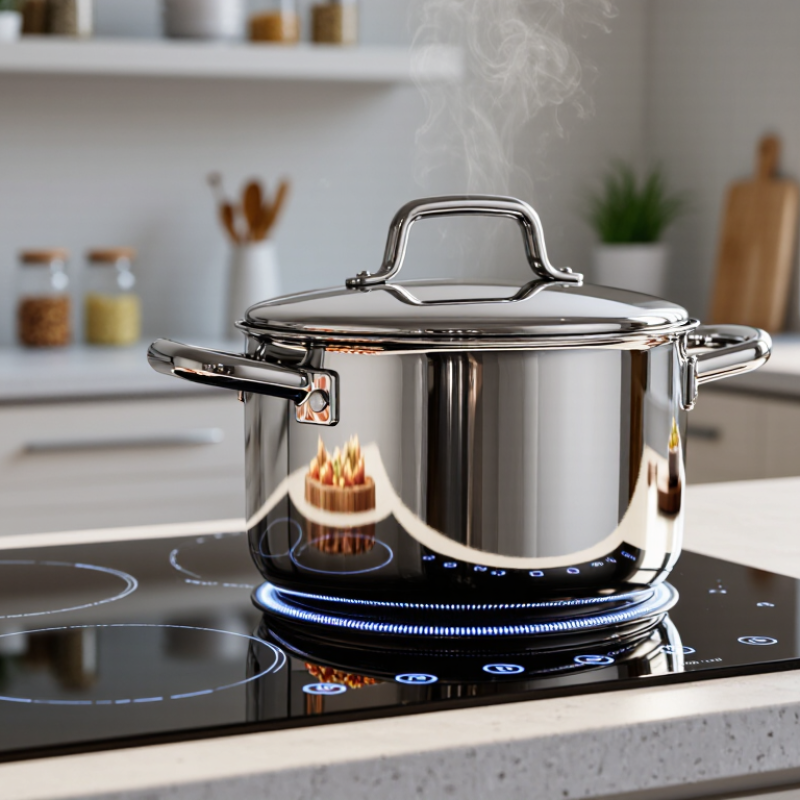
Table of Contents [Hide]
What Is an Induction Soup Pot?
An induction soup pot is a deep cooking vessel designed for an induction cooktop. Its base contains magnetic stainless steel or another ferromagnetic layer. When the cooktop creates a changing magnetic field, the pot itself generates heat. The surface remains comparatively cooler, while broth, vegetables, and meat warm directly inside the vessel. A simple magnet test can confirm compatibility.
The design suits soups because its tall walls reduce splashing and hold steady simmering liquid. Many models also use thick, multi-layer bases to distribute heat more evenly.
According to the U.S. Department of Energy, induction cooking can transfer about 85% of energy to cookware, compared with roughly 32% for gas. ENERGY STAR reports that induction cooking is typically more efficient than conventional electric cooking as well. These figures explain why less heat escapes around the pot.
However, the label can mislead. Not every stainless-steel pot works. A thin base may create hot spots, even when the soup looks calm. In practical kitchen testing, lifting the pot can interrupt heating immediately. That responsiveness is useful, but it also demands closer attention.
The International Energy Agency identifies efficient electrification as an important route for reducing household energy use, yet actual savings depend on electricity sources, cooking habits, and pot construction. Real kitchens are messier.