-
PRODUCTS & SERVICESOptimized cooling solutions for modern data centersProducts & ServicesOptimized cooling solutions for modern data centers
-
CAPABILITIESAdvancing liquid cooling technologiesCapabilitiesAdvancing liquid cooling technologies
-
TechnologiesLiquid Cooling InnovationTechnologiesLiquid Cooling Innovation
-
RESOURCESLatest News & InformationResourcesLatest News & Information
-
ABOUTOur history, leadership and ownershipAboutOur history, leadership and ownership
-
CONTACTFacility locations and global operational footprint






Why Choose a Galvanized Water Tank for Global Buyers?
Safe water storage is no longer a minor infrastructure concern. The WHO and UNICEF Joint Monitoring Programme reported that 2.2 billion people lacked safely managed drinking water services in 2022. For global buyers, dependable storage can protect supply during droughts, transport delays, and unstable municipal networks.
A Galvanized water tank offers a practical balance between strength, corrosion resistance, and installation flexibility. Its steel body supports large capacities, while a zinc coating helps shield exposed surfaces from moisture. Hot-dip galvanizing should be evaluated against recognized standards, including ISO 1461 or ASTM A123/A123M. These standards address coating quality, thickness, and inspection requirements. They do not guarantee performance in every environment.
Water chemistry matters. High acidity, salinity, or unusual mineral content can shorten service life. Indoor placement, roof design, fittings, and maintenance also influence results. This is where procurement decisions become less simple. A low purchase price may hide expensive transport, coating repairs, or difficult access.
The World Bank has repeatedly linked reliable water infrastructure with public health, resilience, and economic productivity. However, no tank solves poor planning. Buyers should compare certified materials, local climate data, cleaning access, warranty terms, and supplier testing records. A visible zinc finish is useful, but it is not proof of total quality.
For many projects, galvanized steel remains a credible and widely understood option. It is not a universal answer. Careful specification is still essential.
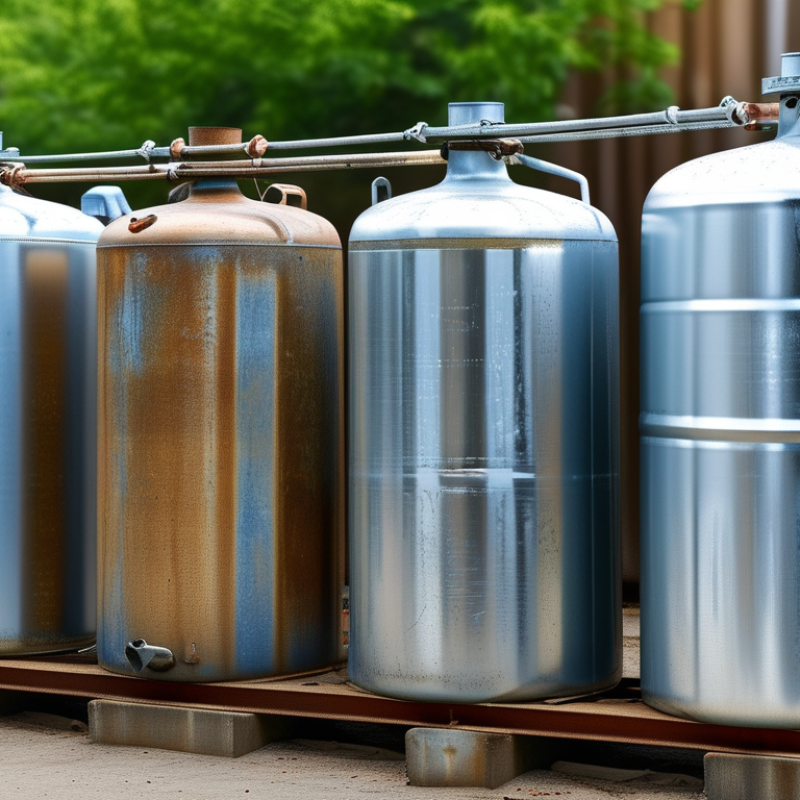
Table of Contents [Hide]
What Is a Galvanized Water Tank?
A galvanized water tank is usually made from carbon steel coated with zinc through hot-dip galvanizing. The steel provides structural strength, while the zinc layer protects exposed areas from corrosion. It works in two ways: the coating separates steel from water, and zinc acts sacrificially when small scratches appear.
The coating is not paint. According to ISO 1461:2022, hot-dip galvanized steel must meet specified coating thickness requirements, verified by inspection. The American Galvanizers Association reports atmospheric zinc corrosion rates commonly below 1 micrometer per year in rural environments, although humidity, salt, and industrial pollution can change performance sharply. Real conditions matter.
For buyers, water chemistry deserves attention. The U.S. Environmental Protection Agency lists 5 mg/L as zinc’s secondary drinking-water standard, mainly linked to taste and appearance. A tank intended for potable water should therefore match local regulations, lining requirements, and testing procedures. Galvanized steel is durable, but it is not a magic shield. Poor weld repairs, trapped moisture, or unsuitable water can shorten its service life. I have seen specifications focus on steel thickness while ignoring coating damage at fittings. That is an avoidable mistake. A credible supplier should provide coating records, material certificates, weld inspection details, and maintenance guidance before shipment.
Why Choose a Galvanized Water Tank for Global Buyers?
What Is a Galvanized Water Tank? Key material, performance, installation, and purchasing considerations
| Evaluation Dimension | Typical Galvanized Water Tank Data | Why It Matters to Global Buyers |
|---|---|---|
| Definition | A galvanized water tank is a storage tank made from steel components coated with zinc to help protect the steel from corrosion. | The zinc coating provides a protective barrier and can also offer sacrificial protection if the steel surface is locally scratched. |
| Common Construction | Modular hot-dip galvanized steel panels, internal sealing membrane or liner, roof structure, access fittings, and connection nozzles. | Bolted modular panels can be transported in compact packages and assembled on site, which is useful for remote projects and international shipping. |
| Typical Capacity Range | Approximately 5 m³ to more than 5,000 m³, depending on panel dimensions, tank height, diameter, structural design, and project requirements. | The broad capacity range supports domestic water storage, agricultural irrigation, fire-water reserves, municipal systems, and industrial applications. |
| Typical Panel Sizes | Common modular panels are approximately 1 m × 1 m, 1 m × 2 m, or similar sizes; exact dimensions vary by manufacturer and engineering design. | Standardized panels simplify replacement, packing, handling, and expansion while allowing the tank footprint to be adapted to the available site. |
| Zinc Coating Principle | Zinc protects steel through a physical barrier and galvanic, or sacrificial, action. Coating thickness is specified by the applicable standard and product design. | Buyers should request the coating specification, inspection method, and applicable standard instead of relying only on the word “galvanized.” |
| Corrosion Resistance | Good resistance in many atmospheric and water-storage environments when the coating, liner, fittings, and site conditions are properly selected. | Performance depends on water chemistry, humidity, salt exposure, coating quality, drainage, and maintenance. Highly aggressive water may require additional protection. |
| Expected Service Life | Often designed for several decades, but the actual service life varies significantly with zinc coating mass, exposure conditions, liner condition, and maintenance. | A service-life estimate should be based on the project environment and corrosion category rather than a universal fixed number. |
| Operating Temperature | Many liner-equipped water tanks are intended for ambient or moderately warm water. A common design reference is around 0°C to 40°C, subject to the liner specification. | Temperature limits must be confirmed for the specific liner, sealant, fittings, and local climate, especially in freezing or hot regions. |
| Water Compatibility | Suitable designs are available for potable water, process water, irrigation water, wastewater, and fire-water storage, provided the lining and components match the use. | Potable-water projects require materials, coatings, membranes, and manufacturing processes that comply with the regulations of the destination market. |
| Installation Method | Usually assembled on a prepared concrete foundation using bolted panels, sealing systems, roof components, ladders, vents, overflows, and pipe connections. | Site assembly reduces the need to transport a fully fabricated tank and can shorten access-related restrictions on difficult project locations. |
| Installation Requirements | A level, properly designed foundation; accurate panel alignment; correct bolt tightening; suitable sealing; safe lifting equipment; and qualified installation personnel. | Poor foundation preparation or sealing can cause leakage and structural problems, so installation quality is as important as the tank material. |
| Maintenance Needs | Periodic inspection of the roof, vents, overflow, access points, bolts, sealants, liner, foundation, and water quality. Cleaning frequency depends on the stored water. | Routine inspection helps identify liner damage, blocked vents, settlement, leakage, or corrosion at cut edges and accessories before major repairs are needed. |
| Transport Efficiency | Flat or compact steel panels and packaged accessories generally require less shipping volume than a fully assembled cylindrical tank of the same storage capacity. | Compact packing can simplify container loading, reduce access constraints, and make international delivery to remote sites more practical. |
| Expansion and Repair | Modular tanks can often be enlarged by adding compatible panels or repaired by replacing individual panels, seals, liners, or accessories. | Component-based maintenance can reduce downtime and avoid replacing the entire tank after localized damage. |
| Key Standards to Confirm | Structural design codes, potable-water approvals where required, welding or bolting specifications, coating standards, liner requirements, and local building regulations. | Standards differ by country and application. Confirming them before production helps prevent customs, inspection, approval, or installation delays. |
| Main Advantages | Corrosion protection, modular construction, scalable capacity, relatively efficient transport, flexible installation, and compatibility with different liner systems. | These characteristics make galvanized tanks a practical option when project location, storage volume, delivery route, and future expansion must all be considered. |
| Important Limitations | The tank is not automatically suitable for every chemical or water condition. Zinc, liner, sealant, and accessory compatibility must be evaluated for the application. | Buyers should review water analysis, ambient conditions, wind and seismic requirements, foundation design, and local compliance documents before ordering. |
Note: The figures and ranges above are typical industry reference values rather than universal specifications. Final capacity, dimensions, coating requirements, temperature limits, liner selection, structural design, and service-life expectations must be confirmed through project-specific engineering.