-
PRODUCTS & SERVICESOptimized cooling solutions for modern data centersProducts & ServicesOptimized cooling solutions for modern data centers
-
CAPABILITIESAdvancing liquid cooling technologiesCapabilitiesAdvancing liquid cooling technologies
-
TechnologiesLiquid Cooling InnovationTechnologiesLiquid Cooling Innovation
-
RESOURCESLatest News & InformationResourcesLatest News & Information
-
ABOUTOur history, leadership and ownershipAboutOur history, leadership and ownership
-
CONTACTFacility locations and global operational footprint




06.03.2026 | Blog Posts, News, Products & Technology
How Liquid Cooling Became the Backbone of AI Infrastructure
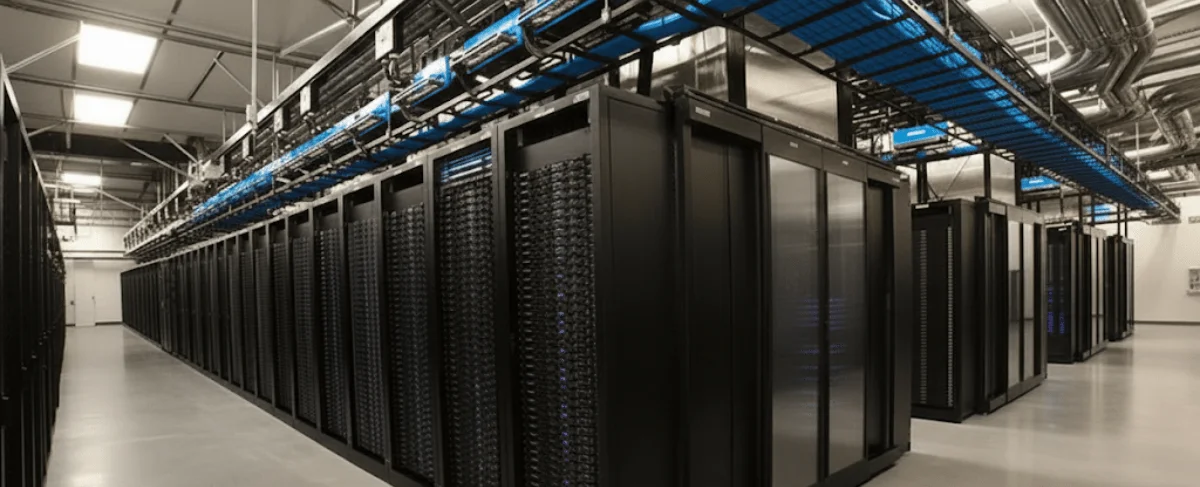
For decades, liquid cooling lived on the margins of data center design, a novelty solution reserved for supercomputers and hobbyist gaming rigs. But today, it’s clear: liquid cooling is no longer an outlier. It is critical infrastructure for AI-scale computing.
The historical arc of liquid cooling is long and deliberate. It was first deployed in the 1970s to cool mainframes like the Cray-1 and IBM 3090. In the early 2000s, it reappeared in the enthusiast PC market, where hobbyists could overclock their gaming rigs. By the 2010s, server OEMs, hyperscalers and research institutions began testing direct liquid cooling (DLC) in preparation for higher thermal demands.
Still, mainstream adoption lagged. Between 2017 and 2023, chip thermal design power (TDP) rose steadily but could still be cooled by traditional air cooling methods. This was the “waiting period.” Air cooling was extended, through a variety of optimizations ensuring its continued viability at scale.
At the same time, one major hyperscaler had already deployed direct liquid cooling at scale as early as 2017, demonstrating its feasibility in production environments, while much of the industry continued to experiment.
During this period, the DLC ecosystem matured – cold plates, CDUs, manifolds, firmware and operational models were developed for niche applications, lying in wait for something bigger.
That “something” arrived in 2024. The expanded use of artificial intelligence drove the necessity of high-performance AI processors like NVIDIA’s H100, which required liquid cooling to maintain performance. Next, rack densities exceeded 100 kW and air cooling could no longer handle the load. This marked the start of mainstream, widespread DLC adoption.
The industry quickly progressed through the Gartner hype cycle. The slope of enlightenment, often spanning years, was compressed into a short period.
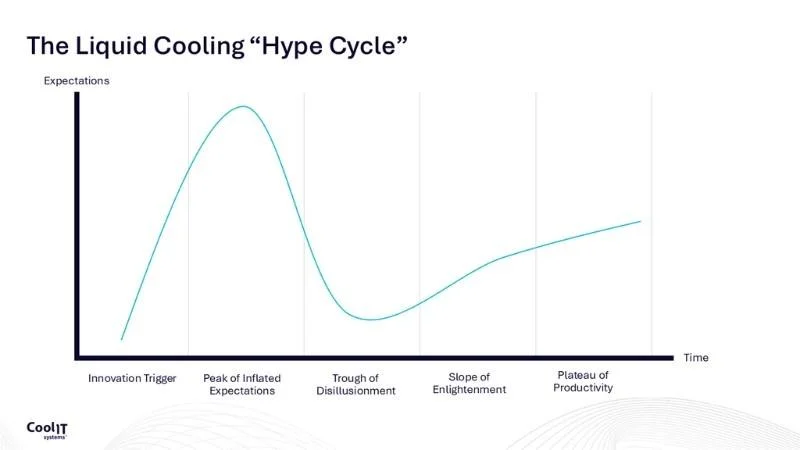
Today in 2026, we find ourselves in the early plateau of productivity. Liquid cooling is no longer experimental, it’s being deployed at scale.
The next phase is about balance between standardization and innovation. Industry-wide efforts around universal quick disconnects, flow rates and pressure thresholds are helping to reduce complexity and cost. But liquid cooling is still evolving.
As processors are validated at power levels approaching 4 kW and beyond, the industry is advancing cold plate technology to keep pace. Meeting these requirements will depend on improved cold plate designs, including 4 kW capacity solutions such as those developed by CoolIT, along with lower pressure drop and higher flow rates to sustain reliable thermal performance.
That leads us to what’s next
First, full heat capture. With rack densities reaching 300kW or more, even 10 to 20% of residual heat left to air cooling represents tens of kilowatts, this is inefficient and ineffective. Higher levels of heat capture will be utilised to capture more and more of the heat.
Second, multi-megawatt CDUs. The same way data centers scaled from megawatts to gigawatts, cooling infrastructure must now follow. Liquid-to-liquid CDUs rated in the multi-megawatt range will be necessary to support 1MW+ racks.
Last, the industry is now designing not just for racks but for regions. Gigawatt-scale campuses are already being announced. These facilities require global supply chains, high reliability and experienced liquid cooling technical service experts. Reliability and uptime are critical as cooling systems grow in number and complexity.
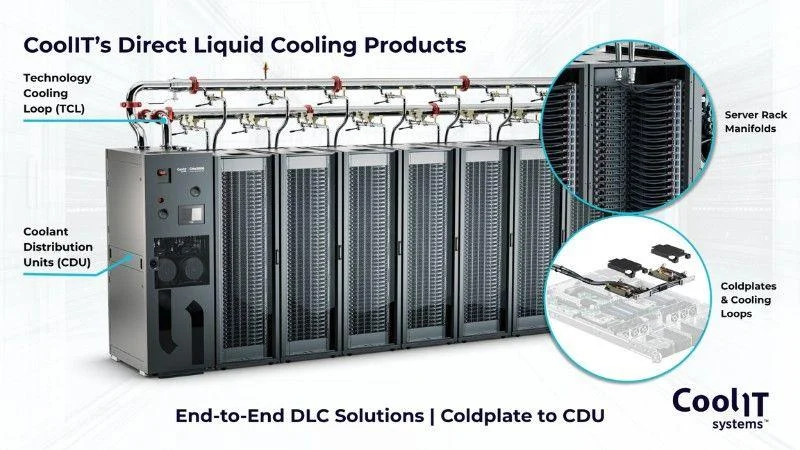
Single-phase DLC, particularly with water-based fluids, continues to be the most mature and most widely deployed approach. Immersion cooling and two-phase technologies have gained interest for belief that they can cool higher heat fluxes. However, these technologies face challenges with system pressure, fluid sustainability and practical deployment.
Direct liquid cooling has moved beyond early adoption. Over the years further innovation and optimization will come to ensure that single-phase DLC becomes the defacto method for cooling generations of high-density AI racks.
Related News & Events
25.02.2026 | Blog Posts, News, Press Releases
CoolIT Systems Continues Rapid Growth as it Celebrates 25 Years
22.01.2026 | News, Blog Posts, Case Study
Customer Showcase: How GWDG Enables AI with CoolIT’s Direct Liquid Cooling
20.01.2026 | Blog Posts, News, Products & Technology
Warm Water Cooling and AI: The Future Is Here but It’s Not Chiller-Free